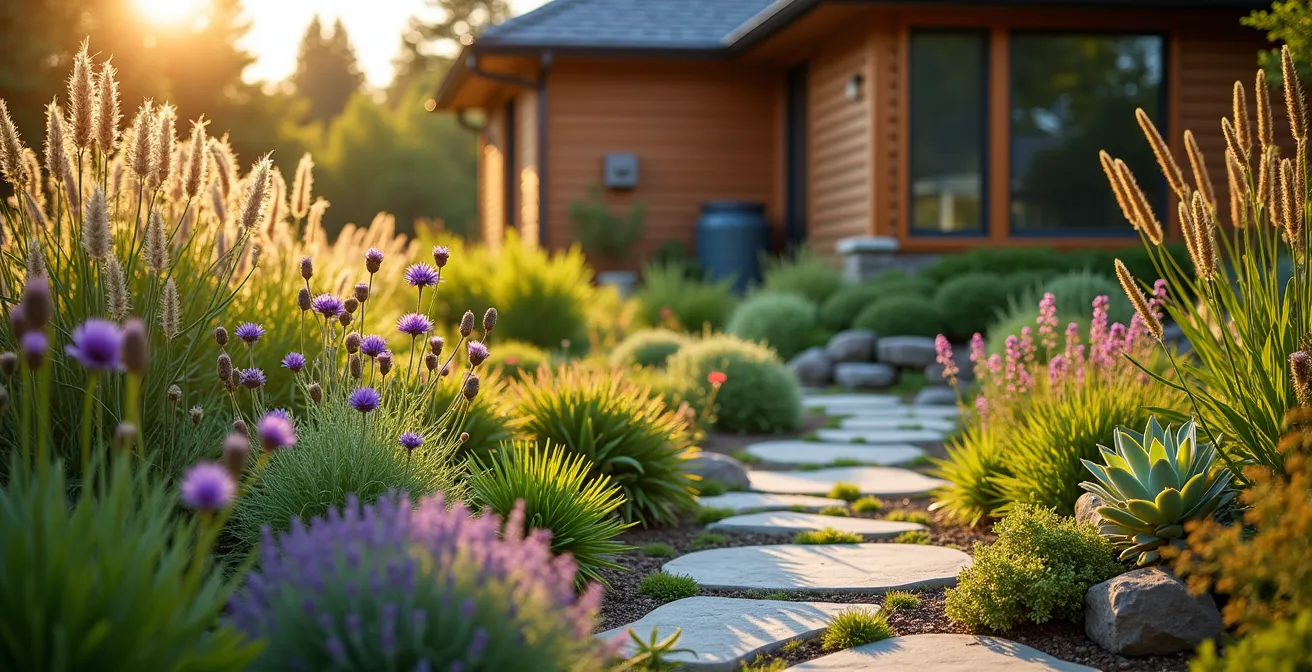
For a Quebec garden that thrives despite heatwaves, the key isn’t to water more, but to create an ecosystem where water is managed in a closed loop.
- Choosing resistant plants (xeriscaping) is only the first step; the core lies in soil improvement.
- Accepting your lawn’s summer dormancy is a natural and beneficial survival strategy, not a failure.
Recommendation: Focus your efforts on spring soil preparation and mulching at the right time to retain maximum moisture, drastically reducing watering needs.
The image has become familiar to every gardener in Canada: a blazing sun in July, cracked soil, and a municipal watering ban hitting at the worst possible moment. The frustration of seeing your efforts and plants wither in the face of summer heatwaves is a growing reality. Many turn to classic solutions, such as installing a rain barrel or selecting a few perennials reputed to be “resistant.” However, these approaches are often just band-aids on a deeper problem.
Faced with increasingly dry summers, simply reacting to drought is no longer enough. The true resilience of a garden is not measured by the amount of water you give it, but by its ability to do without. But what if the real key wasn’t fighting the lack of water, but rather adopting a gardening philosophy where every drop is captured, conserved, and used with maximum efficiency? It’s about moving from a dependent garden to an autonomous ecosystem.
This article proposes a sustainable and forward-thinking approach, specifically designed for the Canadian climate. We will explore how xeriscaping, far beyond the image of a desert, becomes an essential tool for our summers. We will see how to create autonomous groundcovers, optimize rainwater harvesting, and above all, why letting your lawn turn yellow might be the best decision you make this summer. Finally, we will address critical errors to avoid, from nighttime watering to poor soil management that dooms your plants even before winter arrives.
This guide will provide you with concrete strategies to transform your green space into a lush and responsible haven, capable of weathering restrictions with serenity. Let’s dive together into the principles of intelligent gardening adapted to our new climatic reality.
Table of Contents: Creating a Resilient Garden Facing Summer Droughts in Canada
- Why xeriscaping isn’t just for deserts but essential for our dry summers?
- Sedums and hens and chicks: how to create a plant carpet that requires no watering?
- Single rain barrel or series system: what capacity to water a 500 sq. ft. vegetable garden?
- Why your lawn turns yellow in July and why stopping watering is the best thing to do?
- When to apply mulch to conserve up to 50% of soil moisture during heatwaves?
- Why your expensive perennials don’t survive the winter in Zone 5?
- The nighttime watering mistake that promotes fungal diseases on your cucumbers
- How to start a productive vegetable garden in Quebec when you’ve never planted a seed?
Why xeriscaping isn’t just for deserts but essential for our dry summers?
The term “xeriscaping” often evokes images of cacti and gravel, a style poorly suited to the aesthetic of our Quebec gardens. However, this perception is narrow. Xeriscaping is less a style than a philosophy of intelligent water management. Its fundamental principle is simple: design a landscape that minimizes or eliminates the need for supplemental irrigation. Faced with summers where Environment Canada announces particularly dry conditions, this concept becomes a survival strategy for our gardens.
Far from being limited to arid climates, this approach has proven its effectiveness throughout North America, including regions well-supplied with water like Quebec. As highlighted in an analysis on adapting xeriscaping to northern climates, the key to success lies in selecting native or adapted species that are naturally equipped to survive our local conditions. It’s not about turning your garden into a desert, but about making it more resilient by working with nature, not against it.
The basic principles are accessible to all gardeners. It primarily involves improving your soil’s ability to retain water by generously adding compost. Choosing plants adapted to your hardiness zone is crucial, as is the application of protective mulch. Judicious planning, such as grouping plants with similar water needs, greatly facilitates maintenance. Adopting these habits means laying the foundations for a sustainable and economical garden. To go further, Espace pour la vie offers a series of steps to create a garden that thrives with minimal water.
Ultimately, integrating xeriscaping is a forward-thinking choice: that of a magnificent garden that not only survives watering restrictions but prospers through them, while lightening your workload.
Sedums and hens and chicks: how to create a plant carpet that requires no watering?
For those who dream of a lush green corner without ever having to pull out the garden hose, sedums and hens and chicks (Sempervivum) are true allies. These succulent plants are champions of autonomy. Thanks to their fleshy leaves that store water, they can endure long periods of drought without showing the slightest sign of weakness. They quickly form a dense and colorful carpet, smothering weeds and creating a low-maintenance landscape of remarkable resilience.
The appeal of these plants goes far beyond their practical aspect. Their diversity of shapes, textures, and colors allows for the composition of true living mosaics. From the geometric rosettes of hens and chicks with shades ranging from bluish-green to deep purple, to the starry flowers of creeping sedums, the creative possibilities are endless. They are perfect for rock gardens, low walls, sunny borders, and even green roofs.

As can be seen, the textural richness of these plants is exceptional. To succeed in their planting, only one prerequisite: impeccable drainage. These plants fear winter waterlogged soil much more than summer drought. Sandy or gravelly soil, in full sun, is their ideal. Once established, they require practically no care, spreading on their own to densify their coverage year after year.
For Canadian gardeners, it is essential to choose varieties adapted to our hardiness zones. Fortunately, many options are available to create a robust and aesthetic groundcover.
| Variety | Hardiness Zone | Color | Height | Use |
|---|---|---|---|---|
| Sedum spurium | 3 to 9 | Pink-red | 10-15 cm | Dense groundcover |
| Sedum kamtschaticum | 3 to 8 | Golden yellow | 15-20 cm | Rock gardens, walls |
| Sedum acre | 3 to 9 | Bright yellow | 5-10 cm | Green roofs |
| Sedum reflexum | 3 to 9 | Blue-green | 20-25 cm | Slopes, embankments |
By integrating these gems of resilience, you are not just planting a backdrop; you are setting up a miniature ecosystem that takes care of itself, offering you a changing spectacle throughout the seasons, without effort or water waste.
Single rain barrel or series system: what capacity to water a 500 sq. ft. vegetable garden?
Installing a rain barrel is an excellent first step toward water autonomy, but for it to be truly effective, you must think beyond the simple container. The question is not just about collecting water, but knowing if the stored volume will meet your garden’s needs during peak droughts. For a 500 sq. ft. (about 46 m²) vegetable garden, a single 200-liter barrel can empty in just a few days of a heatwave. You must therefore see the barrel not as a gadget, but as the first component of a personal water system.
The sizing of your system depends on two key factors: your roof surface (your collection potential) and the average rainfall in your region. A simple formula allows for a first estimation: roof surface (in sq. ft.) x 0.623 = gallons recoverable per inch of rain. For a 500 sq. ft. vegetable garden, it is often recommended to install at least two 200L barrels in series, especially in cities like Montreal where summer showers can be intense but spaced out. The collective impact of this practice is significant; City of Montreal programs aim to divert up to 70,000 cubic meters of rainwater annually from sewer systems.
Thinking in terms of a “system” also involves planning for surplus management. An overflow system is indispensable. Ideally, it should not return water toward the house foundations, but direct it toward a bioretention area, such as a rain garden or a flowerbed of plants that enjoy moisture. Many Canadian municipalities encourage this practice by offering subsidized barrels at very advantageous prices (often between $20 and $30), making the initial investment minimal. It is therefore essential to check with your locality.
Ultimately, a well-thought-out recovery system transforms a simple shower into a precious strategic reserve, giving you the flexibility to water your vegetable garden even when municipal regulations tighten. It is a concrete investment for the resilience and productivity of your garden.
Why your lawn turns yellow in July and why stopping watering is the best thing to do?
It is a dismal sight for many homeowners: the lush green lawn of June turns into a yellow and straw-like carpet as soon as the first heat of July hits. The first instinct is to water abundantly to bring it back to life. However, this reaction is not only costly and often prohibited, but it also goes against a brilliant survival mechanism of nature: summer dormancy. This yellowing is not a sign of death, but a strategic standby mode.
The majority of lawns in North America are composed of Kentucky Bluegrass (Poa pratensis). As confirmed by a Statistics Canada analysis on grass types, this grass resists drought poorly and requires a lot of water. Faced with water and heat stress, Kentucky Bluegrass does not die; it enters dormancy. It stops growing its leaves (the green part) to concentrate all its energy on the survival of its roots and crown (the base of the plant). Ceasing to water is respecting this natural cycle and allowing it to preserve itself without permanent damage. As soon as cooler temperatures and late summer rains return, it will green up on its own.
Forcing a dormant lawn to stay green through constant watering is a losing battle that depletes water resources and weakens the plant. The best approach is proactive: mow higher (3-4 inches) so the blades of grass create shade for the soil, leave grass clippings (grasscycling) to form a natural mulch, and above all, accept this summer rest. For those who desire a green lawn year-round, the solution is not more watering, but a change in the lawn’s composition.
There are remarkably drought-resistant alternatives adapted to our climates that require much less maintenance than a traditional lawn.
| Type of Lawn | Drought Resistance | Maintenance | Adapted Zone |
|---|---|---|---|
| Micro-clover | Excellent | Very low | Zones 3-8 |
| Creeping red fescue | Very good | Low | Zones 2-7 |
| Perennial ryegrass | Good | Moderate | Zones 3-7 |
| Eco-lawn mix | Excellent | Very low | Zones 3-8 |
By changing our view of the “perfect” lawn, we transform a source of stress and water consumption into a more ecological, economical space that is ultimately more in harmony with the rhythms of our climate.
When to apply mulch to conserve up to 50% of soil moisture during heatwaves?
Mulching is one of the most effective techniques for a water-efficient garden. A good layer of mulch can reduce soil water evaporation by up to 50%, keep roots cool during heatwaves, and limit the growth of weeds that compete for water. However, in Canada, the crucial question is not just if you should mulch, but especially when to do it. Applying mulch too early in the spring is a common mistake that can prove counterproductive.
In the spring, Canadian soil is cold and takes time to warm up. If you apply a thick layer of mulch (which is an insulator) on soil that is still frozen or very cold, you will literally trap the cold. This will delay soil warming, slow the root growth of your perennials and vegetables, and can even hinder their development. The golden rule is therefore to wait until the soil has warmed up well.

The ideal time to mulch depends on your region, but a good indication is to wait until the soil reaches a consistent temperature of about 15°C. Once this moment arrives, apply a generous layer of 8 to 10 cm (3 to 4 inches) of organic mulch such as cedar mulch, straw, shredded dead leaves, or compost. Take care to leave a small gap around the crown of plants to avoid rot risks. Regarding concerns that mulch attracts slugs, it often suffices not to pile it directly against the stems of sensitive plants.
The application schedule varies slightly across the country, reflecting local microclimates:
- Late May to early June in Quebec and Ontario: Wait until the soil reaches 15°C.
- Mid-June in the Maritimes: After the last late frosts that can occur.
- Early May in coastal British Columbia: The milder climate allows for earlier application.
By respecting this climatic timing, mulch becomes your best ally. It transforms your soil into a sponge that retains precious moisture, allowing you to cross drought periods with much more serenity.
Why your expensive perennials don’t survive the winter in Zone 5?
One of the biggest mysteries for Canadian gardeners is seeing a perfectly healthy perennial in the fall never emerge the following spring, even if it was labeled for the correct hardiness zone. We often blame intense cold, but the most common cause of winter mortality is not the frost itself, but rather excess moisture at the root level. Poorly drained soil is the silent killer of many plants, particularly Mediterranean perennials like lavender, rosemary, or santolinas.
The freeze-thaw cycle of our winters and springs is particularly formidable. In heavy, clayey soil that retains water, plant roots find themselves trapped in a mass of waterlogged, icy earth. This stagnant water suffocates the roots and promotes the development of crown rot. The plant doesn’t die of cold; it literally drowns and rots on the spot. This problem is all the more relevant as climate projections for Canada indicate more frequent extreme events, including wetter winters and drier summers.
The solution lies in improving your soil drainage, especially in areas where you plant more sensitive perennials. The good news is that several simple techniques can transform a problematic soil into a welcoming haven for your plants:
- Amend the soil: Incorporate a good amount of organic matter (compost) and coarse sand or fine gravel to improve structure and allow water to flow.
- Create mounds: Planting on raised mounds of 20 to 30 cm is the most effective method. This keeps the plant’s roots above the level of stagnant water.
- Use mineral mulch: For plants very sensitive to crown rot, a gravel mulch around the base of the plant prevents moisture from accumulating against the stem.
- Avoid depressions: Make sure not to create “bowls” around your plants while gardening, which could collect rain or meltwater.
By focusing your attention not only on cold resistance but also on winter moisture tolerance, you will dramatically increase the survival rate of your perennials and ensure a garden that returns strong every spring.
The nighttime watering mistake that promotes fungal diseases on your cucumbers
In an effort to save water and avoid rapid evaporation, many well-intentioned gardeners choose to water their vegetable garden in the evening, after sunset. While the intention is good, the practice can be disastrous for certain plants, notably cucurbits like cucumbers, squash, and melons. Evening watering creates ideal conditions for the development of fungal diseases like downy mildew and powdery mildew.
The problem is simple: when you water the foliage in the evening, the leaves stay wet for long hours through the night because there is no sun to dry them. This stagnant moisture combined with nighttime coolness is a literal incubator for fungal spores. By morning, you find your plants covered in spots or a white powdery coating that will weaken the plant and ruin your harvest. Water usage regulations are often clear on this subject. As the City of Montreal states:
It is preferable to avoid watering plants, flowers, and lawns during the day
– City of Montreal, Water Usage Regulations
This pushes many to water in the evening, but the best time is actually early morning. By watering at dawn, you minimize evaporation while allowing the rising sun time to quickly dry the foliage, depriving fungal diseases of the conditions they need to settle in.
More importantly, the watering method takes precedence over the timing. The goal is to get water to the roots, not to shower the leaves. A study of good watering practices confirms it: slow and deep watering is the key. Using a soaker hose or letting a garden hose run slowly at the base of the plant allows water to penetrate deep into the soil, encouraging roots to develop deeper where they will be better protected from surface drought. This is a much more effective technique than superficial and rapid watering.
By adopting morning and soil-targeted watering, you will not only protect your plants from diseases but also use every drop of water in the most efficient way possible for a healthy and abundant harvest.
Key Takeaways
- A garden’s resilience doesn’t come from watering, but from the soil’s ability to store water. Compost and mulch are your best tools.
- Lawn yellowing in summer is a healthy survival mechanism (dormancy). Stopping watering is the best thing to do to preserve it.
- Timing is crucial in Canada: mulch when the soil has warmed up (late May/early June) and water early in the morning to avoid diseases.
How to start a productive vegetable garden in Quebec when you’ve never planted a seed?
Starting a vegetable garden for the first time can seem intimidating, especially with the constraint of water restrictions. The key to success for a beginner is not to aim big, but to start with a controlled and resilient system that forgives errors and maximizes harvest chances. A raised garden bed is by far the best option for starting in Quebec. It allows total control over soil quality, warms up faster in the spring, and offers excellent drainage—three essential factors for our climate.
To make it even more autonomous, an ingenious technique popularized in Canada is the “wicking bed” or lasagna gardening with a water reservoir. This is a raised bed where a water reservoir is created under the soil, allowing irrigation by capillarity directly to the roots. This method allows for substantial water savings, fewer tedious waterings, and ensures constant hydration for plants, even during a heatwave or your vacation. Harvests are often more abundant because the plants suffer no water stress.

This raised vegetable garden, illustrated here with ollas (terracotta pots for irrigation), shows how passive watering systems can be integrated. For a beginner, it is wise to start with a limited selection of easy and productive vegetables, which are also recognized for their good drought tolerance once established. Focusing on 5 to 7 varieties allows you to properly learn their specific needs without feeling overwhelmed.
To get started concretely, here is a simple action plan to assemble your first water-efficient Quebec vegetable garden.
Action Plan: Your First Resilient Vegetable Garden in Quebec
- Construction: Build or buy a raised garden bed at least 30 cm high, ensuring there are drainage holes.
- Filling: Create an ultra-performing substrate by mixing 1/3 compost, 1/3 good potting soil, and 1/3 vermiculite for optimal water retention.
- Vegetable Selection: Choose 5 to 7 resistant vegetables to start: bush beans, kale, Swiss chard, garlic, and determinate cherry tomato varieties.
- Adding Herbs: Plant perennial and drought-resistant herbs at the border, such as thyme, rosemary, and savory, which will return every year.
- Passive Irrigation System: Install simple systems like ollas (buried clay pots) or inverted, pierced plastic bottles for slow and deep watering.
By starting with this structured approach, you set all the chances on your side. You will learn the basics of gardening on a resilient system that will guarantee not only a rewarding harvest but also the pride of having created a productive garden that respects our most precious resource: water.