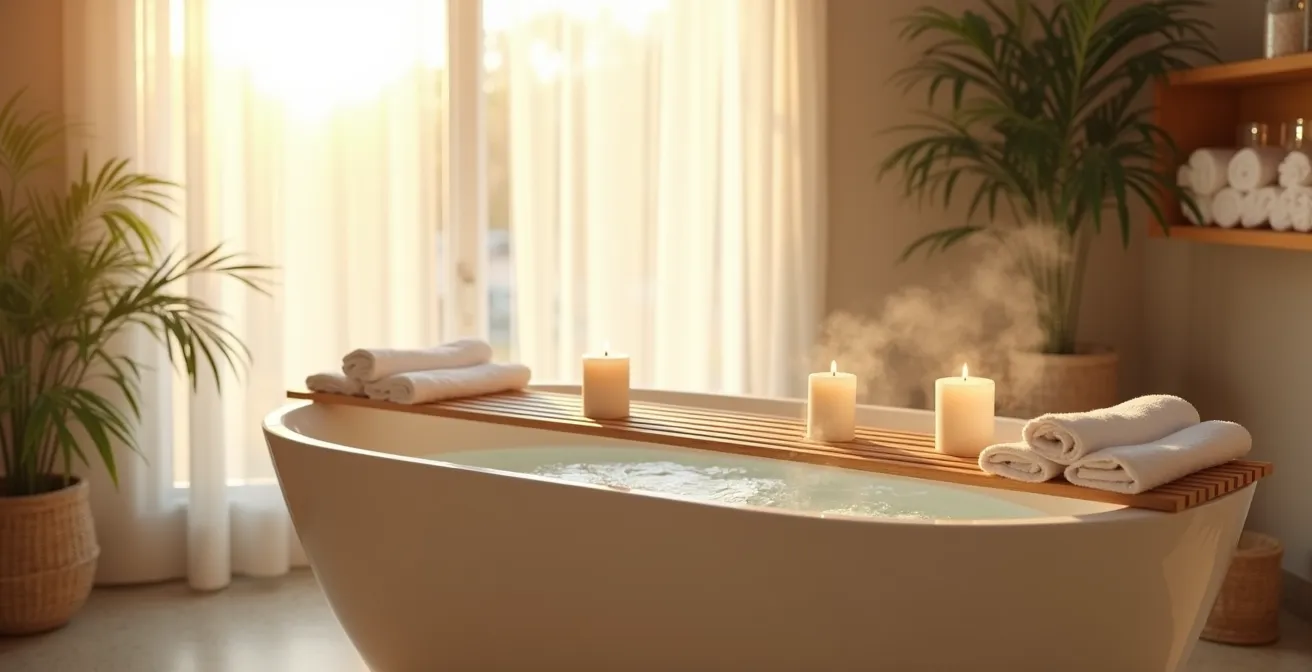
Transforming your bathroom into a spa is less a matter of expense than of strategic investment. The key is to focus on targeted improvements that permanently alter the atmosphere and comfort.
- Prioritize sensory infrastructure: dimmable lighting and a heat source have more impact than accessories.
- Optimize what you have: improve before you replace. Good storage and quality textiles radically change the perception of the space.
Recommendation: Forget costly renovations and focus your $1,000 budget on the “Targeted Comfort” strategy, allocating funds to elements that maximize daily sensory ROI.
The idea of transforming your bathroom into a sanctuary of relaxation, a true home spa, is a dream. Especially when the Canadian winter sets in and the call of a warm cocoon is felt. Spontaneously, we think of scented candles, softer towels, and perhaps a new green plant. We find ourselves admiring majestic freestanding baths on Instagram, seemingly floating in the middle of huge rooms, and we tell ourselves that such luxury is unattainable without major renovations and a significant budget.
Yet, this approach focuses on the accessory rather than the essential. What if the true key to a successful and lasting transformation lay not in the accumulation of decorative objects, but in the strategic improvement of the very infrastructure of your comfort? This is the principle of “Targeted Comfort”: investing every dollar of your $1,000 budget not to decorate, but to fundamentally change the sensory experience of the room. It’s not about spending; it’s about investing in light you can modulate, warmth that envelops you, and order that soothes your mind.
This article will guide you through eight clever investments that prove an authentic spa atmosphere is less about budget and more about strategy. We will deconstruct myths, explore smart alternatives, and give you the keys to creating a wellness space that truly meets your needs without blowing your finances.
To help you navigate this transformation project, this article is structured around the most profitable investment points for your well-being. The summary below will allow you to go directly to the sections that interest you most.
Summary: Creating your personal home spa on a controlled budget
- Freestanding bath: is it actually comfortable for reading or just good for Instagram?
- Why installing a dimmer is the most cost-effective investment for a spa atmosphere?
- Hardwired or plug-in: which towel warmer to choose for a small, cold bathroom?
- Which plants absorb humidity and purify the air in your windowless bathroom?
- How to organize your products to keep a Zen and clear counter every day?
- Why replacing your podium bath with a walk-in shower is a major safety investment?
- Why is underfloor heating better for allergy sufferers than electric baseboards?
- How to install heated flooring without exploding the renovation budget?
Freestanding bath: is it actually comfortable for reading or just good for Instagram?
The freestanding bath has become the emblem of luxury in the modern bathroom. It is sculptural, photogenic, and instantly evokes a high-end spa image. However, beyond the aesthetics, the reality is often less idyllic. These tubs frequently lack practical ledges for a book, a glass, or bath products. Their shape, while stylish, is not always optimized for prolonged comfort, with backrests that are sometimes too straight or a poorly adapted depth. Furthermore, their installation involves complex and expensive plumbing work, which almost always places them outside a $1,000 budget.
Rather than dreaming of a complete replacement, the Targeted Comfort strategy suggests radically improving your existing bathtub. The goal is to maximize comfort and aesthetics with minor but high-impact investments. Here are three alternatives to transform your current bath into a luxurious experience:
- Invest in a professional re-enameling kit: For about $150 to $300, kits available at retailers like RONA allow you to give a yellowed or worn bathtub a white, glossy, like-new finish. The visual impact is spectacular.
- Install a luxury bath caddy: A Canadian brand like Umbra offers sophisticated bath trays ($80-$150) in wood or metal, with supports for books, tablets, and wine glasses. This accessory instantly transforms your bath use into a true relaxation ritual.
- Add an ergonomic bath pillow: For $50 to $100, a high-quality pillow supports the neck and shoulders, making long baths infinitely more comfortable than in many freestanding models.
By combining these three improvements, you spend less than $500 to obtain 90% of the comfort and aesthetics of a new installation, while maintaining the practicality of your integrated bath.
Why installing a dimmer is the most cost-effective investment for a spa atmosphere?
Lighting is undoubtedly the most powerful and least expensive element to radically transform an atmosphere. A functional bathroom, lit by harsh white light, can instantly become a soothing haven of peace thanks to dimmed and warm lighting. Forget candles, whose effect is temporary and limited. Installing a dimmer is a minor structural modification that offers maximum sensory ROI. It is the best-kept secret for an authentic and accessible spa atmosphere.
The main advantage of a dimmer is its versatility. It allows you to “sculpt” the light according to your needs: maximum intensity in the morning to get ready, and a soft, warm glow in the evening to relax. For a surprisingly modest budget, you can acquire sophisticated technology. For example, the Lutron Caséta Smart Dimmer is available for $79.98 CAD at Home Depot Canada. This one-time investment changes the perception of the entire room.
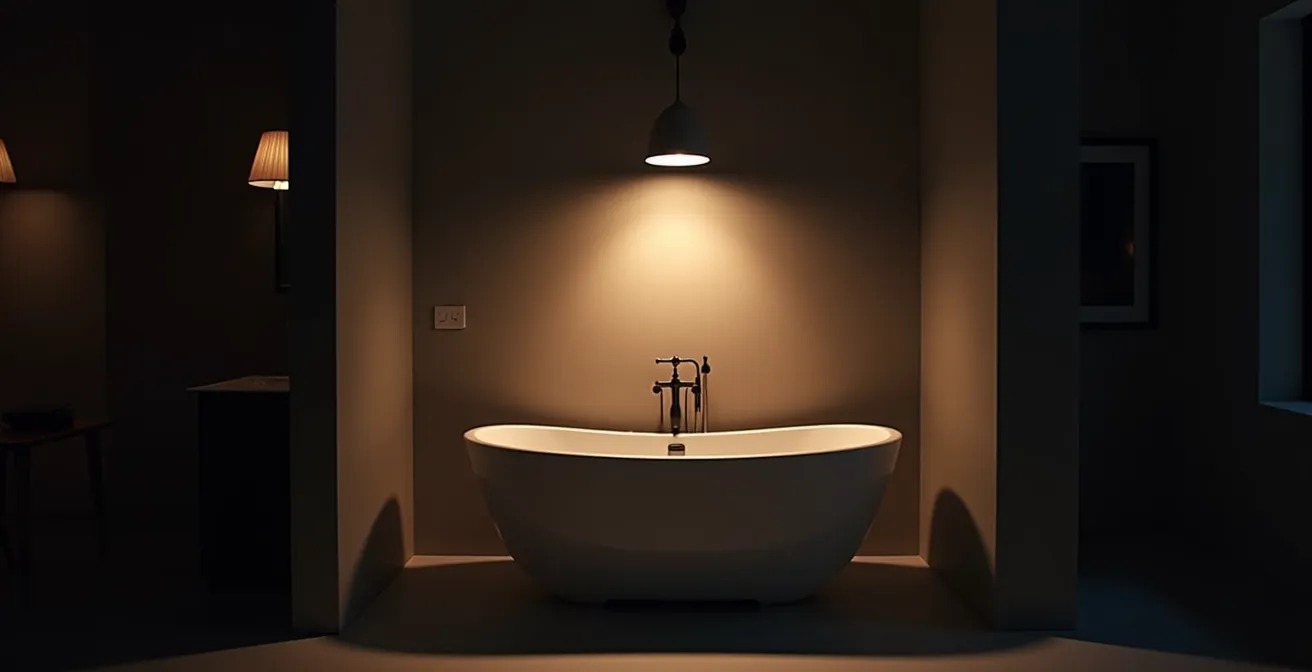
Integrating a smart system takes the experience even further. As shown in the following case study, it’s no longer just about lowering the light, but about creating real relaxation scenarios.
Case Study: Installing a smart lighting system with Google Assistant
The Caséta dimmer allows you to create personalized scenarios via the Lutron app. With the Smart Bridge (a small additional box), you can control up to 75 devices and create “Nordic Spa” atmospheres activated by voice command. Compatible with Alexa, Apple HomeKit, and Google Home, the system adjusts automatically according to the time of day, creating an effortless immersive spa experience. Saying “Ok Google, activate relaxation mode” can dim the lights to 20%, change their color if you have compatible bulbs, and even start a relaxing playlist.
Hardwired or plug-in: which towel warmer to choose for a small, cold bathroom?
Stepping out of a hot shower only to wrap yourself in an icy towel is the antithesis of the spa experience. In a country like Canada, where winters are long and harsh, heat is not a luxury but a fundamental need. A towel warmer is one of the wisest investments to bring tangible, daily comfort. It not only warms your towels but also helps temper a small bathroom, reducing the feeling of cold and ambient humidity. The question is therefore not “should I install one?” but “which model to choose?”.
The choice mainly boils down to two options: the hardwired model and the plug-in model. Each has its advantages and constraints, and the choice will depend on your status (owner or renter) and your budget. The following table details the key differences to help you decide.
This comparison highlights the dilemma between a permanent solution that adds value and a flexible, affordable option. For a $1,000 budget, the plug-in model is clearly the simplest and fastest way to comfort.
| Criterion | Hardwired Model | Plug-in Model |
|---|---|---|
| Average Price | $400-$800 + installation | $200-$400 all-inclusive |
| Installation | Electrician required ($250-$400) | DIY installation in 30 min |
| Consumption | 200W (like 2 light bulbs) | 40-250W depending on model |
| Resale Value | Increases perceived value | No impact (portable) |
| Ideal For | Homeowners | Renters |
The impact of this device goes far beyond its primary function. As Nordic Canada highlights in its product description, its role is also psychological. It is a promise of comfort after facing the cold.
The towel warmer is not a gadget but a comfort essential for surviving winter, providing immense sensory added value when it is -20°C outside.
– Nordic Canada, Product Description Home Depot Canada
Which plants absorb humidity and purify the air in your windowless bathroom?
Integrating nature into your bathroom is a simple and economical way to create a spa atmosphere. However, not all plants are adapted to this unique environment, often characterized by high humidity and low light, especially in windowless bathrooms. The key is to choose species that not only survive but thrive in these conditions. This is called functional biophilia: plants that are not just decorative, but actively participate in the balance of your room’s ecosystem by absorbing excess humidity and purifying the air.
Many tropical plants are perfectly adapted. They naturally evolve in humid and shaded undergrowth, which makes your bathroom very similar to their original habitat. Forget cacti and succulents that would rot quickly; instead, turn to robust and tolerant varieties.

Here is a selection of five champion plants, easy to find in Canadian garden centers, that will transform your bathroom into a green oasis:
- Zamioculcas (ZZ Plant): Almost indestructible, it requires very little light and handles variations in humidity well. You can easily find it at Loblaws or local nurseries.
- Sansevieria (Snake Plant): Recognized for its air-purifying properties, it is extremely tolerant of low light. Garden sections at Canadian Tire often stock them.
- Pothos: This trailing plant loves high humidity, which helps prevent mold formation. Its long stems can be guided to create a green cascade effect.
- Spathiphyllum (Peace Lily): With its elegant white flowers, it indicates when it’s thirsty by drooping its leaves. Place it near the shower so it can benefit from the steam.
- Philodendron: Very hardy, this plant requires little care and average lighting is more than enough for it to flourish.
How to organize your products to keep a Zen and clear counter every day?
A bathroom counter cluttered with bottles, tubes, and various accessories is the main enemy of a spa atmosphere. Visual clutter creates mental stress that sabotages any attempt at relaxation. The solution is not to stop using products, but to adopt an intentional approach to storage. It’s about transforming a chore into a storage ritual, where every object has its place and contributes to the harmony of the space.
The idea, popularized by designers like Toronto’s Tim Lam, is to create a “Ritual Spa Kit.” Instead of leaving all your products in plain sight, you select only those necessary for your relaxation session (an artisanal soap, a bath oil, a moisturizing cream) and arrange them on a dedicated tray. The rest of the time, this tray is stored away, leaving the counter perfectly clear. This approach has a double advantage: it forces organization and it sacralizes the bath moment by preparing it as a ritual.
To implement this philosophy, here are some storage solutions inspired by Canadian designers:
- Install Umbra organizers (Toronto): The brand offers minimalist trays and elegant storage boxes ($30-$60) that structure the space without weighing it down.
- Choose EQ3 baskets (Winnipeg): Their contemporary Nordic design is perfect for grouping rolled towels or larger products ($40-$80).
- Opt for products with minimalist packaging: Canadian brands like The Ordinary, Attitude, or BKIND offer not only quality products but also packaging that becomes decor elements.
- Use glass jars: Transferring cotton swabs, bath salts, and cotton pads into harmonious glass containers unifies the aesthetic and eliminates the chaos of commercial packaging.
Your action plan for a Zen counter
- Clutter touchpoints: List all the places where products accumulate (counter, bath ledge, shelf).
- Collect and sort: Empty everything. Discard expired products and group the others by category (face care, body, hair).
- Consistency with the spa atmosphere: Keep only the products you use daily within reach. The others should be stored out of sight (cabinets, baskets).
- Memorability and aesthetics: Invest in 2-3 beautiful containers (jars, tray) for the products you leave visible. The goal is to create a decorative “vignette.”
- Integration plan: Define a place for everything. The “Ritual Spa Kit” on its tray, towels in a basket, the rest in the cabinet. The counter should remain 95% empty.
Why replacing your podium bath with a walk-in shower is a major safety investment?
Podium baths—those large built-in tubs surrounded by tiled steps—were very popular in the 90s and 2000s. Today, they are not only out of style but also represent a significant safety risk. Stepping over a wide, slippery ledge to get in and out of the shower is a frequent cause of falls, especially for people with reduced mobility or seniors. Replacing this behemoth with a walk-in shower (curbless) is therefore much more than a simple aesthetic modernization: it is a major investment in the safety and accessibility of your home.
The Canadian government recognizes the importance of such work. Thanks to the Home Accessibility Tax Credit (HATC), you can claim a portion of the expenses related to renovations that improve safety. In fact, the federal government offers the HATC allowing you to claim up to $10,000 in eligible expenses. Furthermore, a recent analysis of the Quebec real estate market reveals that a renovation including a walk-in shower offers a return on investment (ROI) of 58%, barely lower than that of a bathtub (60%), but with an incomparable safety advantage.
While a complete conversion exceeds the $1,000 budget, it is possible to simulate the effect and comfort of a walk-in shower for less than $200 with these three improvements:
- Replace the curtain with a hotel-style model on a curved rod ($50-$80): The curved rod increases the interior space of the shower, creating a feeling of openness.
- Install a rainfall showerhead ($60-$100): Available at Home Depot, this type of showerhead offers a total immersion experience, a signature of spa showers.
- Add a bamboo bath mat ($40-$60): Upon exiting, it provides a stable, natural, and aesthetic surface that evokes Asian spas, while drying quickly.
These clever adjustments improve both perceived safety (more space, less contact with a sticky curtain) and the sensory experience.
Why le heating au sol is it better for allergy sufferers than electric baseboards?
The ultimate dream of comfort in a bathroom, especially in Canada, is heated flooring. Stepping barefoot onto a warm floor in the morning is a feeling of incomparable luxury. But beyond comfort, radiant floor heating has a major health advantage, particularly for people suffering from allergies. Unlike electric baseboards that work by convection (heating air so it circulates), floor heating works by radiation. It directly heats objects and people in the room without creating air currents.
This mode of operation is crucial: electric baseboards stir the air, lifting and keeping dust, mites, and other allergens in suspension. Radiant heating ensures healthy and consistent warmth without air movement, contributing to a much purer indoor environment. Unfortunately, installing a real floor heating system is a costly project that requires completely redoing the floor.
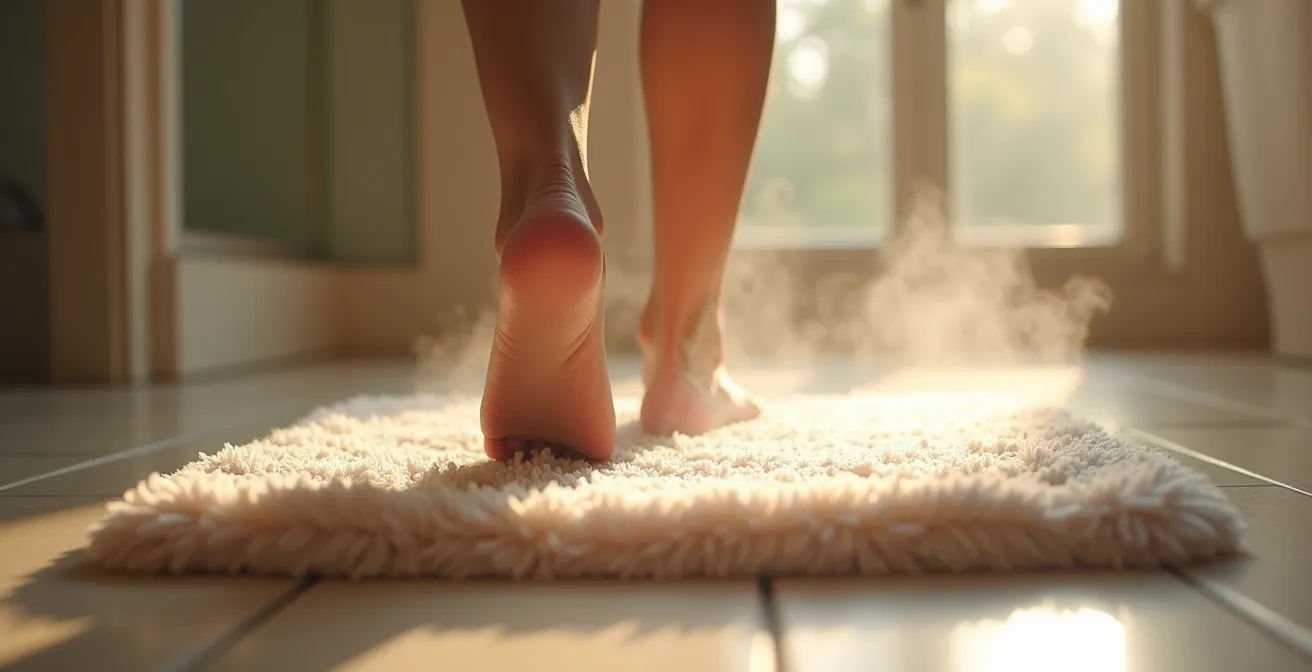
Fortunately, there is a clever alternative that offers much of the benefit for a fraction of the price. This is where the heated bath mat comes in, a brilliant and affordable solution.
Case Study: The heated bath mat, an affordable alternative
Electric heated bath mats, available on platforms like Amazon.ca, offer 80% of the comfort of a heated floor for only 5% of the price ($50 to $150 compared to over $3,000 for a full installation). Compared to the ultra-thick memory foam mats from Simons, they don’t just feel plush; they provide upward warmth that relieves muscle tension and improves circulation. This is a crucial advantage after a long day of winter sports or shoveling, a very Canadian reality.
Key Takeaways
- A successful spa transformation prioritizes sensory infrastructure (light, heat) over accessories, offering a better ROI in comfort.
- Smart and budget-friendly alternatives, like a heated bath mat or bathtub re-enameling, provide 90% of the benefits for 10% of the cost of a renovation.
- Organization is not a constraint but a key element of the spa atmosphere; adopting a “storage ritual” clears visual and mental space.
How to install heated flooring without exploding the renovation budget?
We have established that heated flooring is the gold standard of comfort, but also that it is financially out of reach within a $1,000 budget. The temptation might be to dedicate the entire sum to a single ambitious project, but that would be a mistake. As a renovation expert cited by Travaux Québec summarizes, one must be realistic. This quote puts things into perspective and forces us to think differently.
You won’t do it for less than $1,000. The real cost of a professionally installed heated floor system in Canada is several thousand dollars.
– Renovation Expert, Travaux Québec
Faced with this reality, the answer is not abandonment, but strategy. Since a single luxury element is unaffordable, the solution is to intelligently distribute the budget across several fronts to create an overall spa effect. This is the culmination of our “Targeted Comfort” approach. Instead of aiming for a single perfect improvement, we orchestrate a symphony of small, high-sensory-ROI improvements.
The following table proposes a strategic allocation of your $1,000 budget. This is not a list of expenses, but an investment plan for a complete and tangible transformation. Each line represents a deliberate choice to maximize the spa atmosphere with limited resources.
| Element | Allocated Budget | Comfort Impact |
|---|---|---|
| Smart Dimmer | $250 | Instant spa atmosphere |
| Plug-in Towel Warmer | $300 | Ambient warmth + warm towels |
| Luxurious Textiles (towels, mat) | $150 | Premium tactile sensation |
| Purifying Plants | $100 | Purified air + aesthetics |
| Accessories (tray, organizers) | $200 | Zen organization |
| TOTAL | $1,000 | Complete Transformation |
By following this plan, you are not just buying objects; you are building a wellness ecosystem. This is proof that with $1,000 and a good strategy, it is entirely possible to create a home spa that you will enjoy every day, much more than with a single expensive renovation.