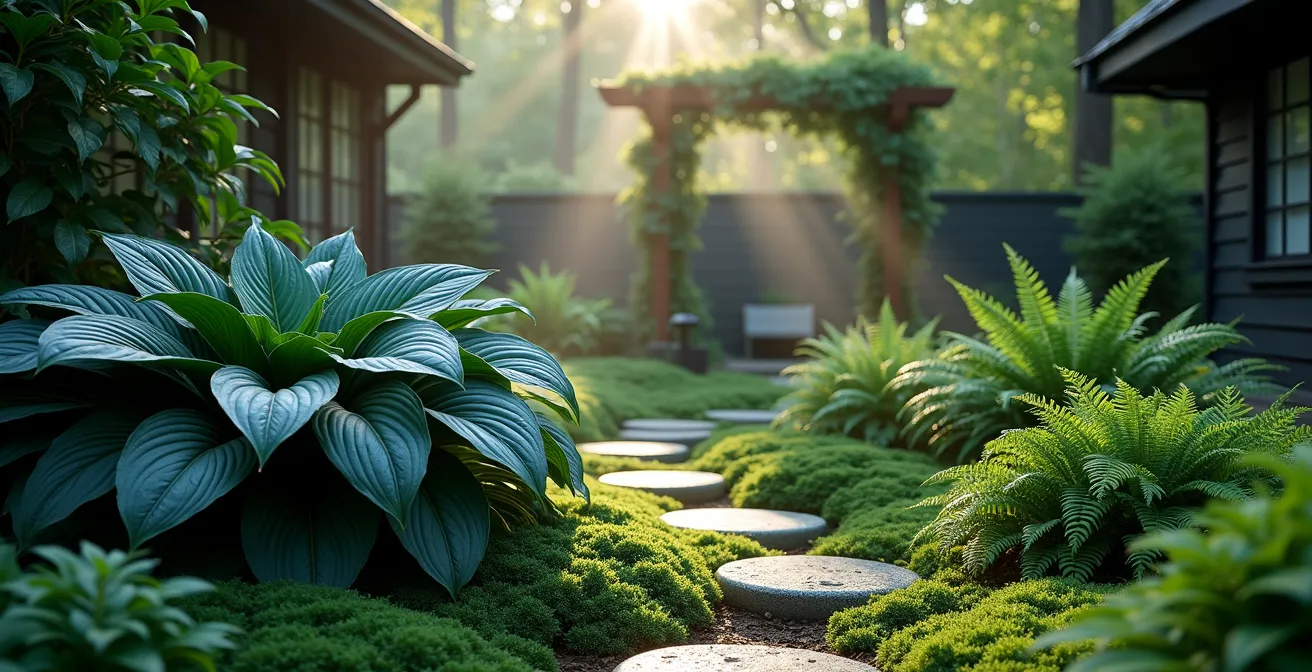
Transforming a dark, damp corner into a lush haven is not a matter of luck, but an ecological strategy adapted to the Canadian climate.
- Stop the struggle against shade by choosing native plants that thrive in it naturally.
- Adopt integrated management of water, light, and pests to create a balanced ecosystem.
- Value shade for its unique cooling effect and immense aesthetic potential.
Recommendation: Begin by observing your soil and the type of shade (dense, partial) to select the right plant guilds that will work together.
That corner of your yard, perpetually ignored by the sun, where grass struggles to grow under the large maple or against the north-facing wall. For many Canadian homeowners, this space is a source of frustration—a problem to be solved. The common reflex is to persist, attempting to force nature by planting annuals that wither, or worse, to surrender by covering the area with mulch or gravel, creating a sterile desert. We resign ourselves, thinking that nothing vibrant can live there.
Usual advice is often limited to a short list of tolerant plants: hostas, ferns, hydrangeas. While these choices are valid, they are merely isolated notes in a much richer score. The approach we propose is that of a landscape architect: to consider this shaded corner not as a constraint, but as an exceptional backdrop. What if the true key wasn’t simply “planting in the shade,” but composing a genuine botanical symphony—a resilient and self-sustaining micro-ecosystem?
This article will guide you to become the conductor of your shade garden. We will debunk myths, reveal why you should stop fighting moss, and show you how to create smart plant associations that repel slugs. Together, we will transform this challenge into a sanctuary of coolness, textures, and life, perfectly adapted to the reality of our Canadian seasons.
To support you in this transformation, we have structured this guide into several key steps. Each section addresses a specific challenge and offers concrete, inspiring solutions, allowing you to navigate from botanical choices to practical landscaping.
Summary: Creating a Flourishing Ecosystem in Shaded Areas
- Which giant hosta varieties best resist slugs while brightening the shade?
- Shade sail or louvered pergola: what to choose for sun control on a South-facing deck?
- The mistake of trying to grow tomatoes with less than 6 hours of sun that leads to failure
- Why fighting moss in the shade is useless and what to replace it with advantageously?
- How landscaping a shaded area can reduce the felt temperature by 5 to 8 degrees?
- Why planting citronella is often insufficient to repel mosquitoes in Canada?
- The trap of designing a glass-enclosed area without providing adequate ventilation for July
- How to enjoy your yard in the evening without being eaten alive by mosquitoes?
Which giant hosta varieties best resist slugs while brightening the shade?
The hosta is the undisputed king of the shade garden, but its splendor is often threatened by a voracious enemy: the slug. The solution lies not in an endless chemical battle, but in a selection and association strategy. The example of the Montreal Botanical Garden’s Shade Garden, with its more than 1,000 species, teaches us that diversity and judicious choices are the pillars of a healthy garden. Instead of choosing just any hosta, the landscape architect turns to cultivars whose very texture acts as armor.
Varieties with thick, puckered, almost leathery leaves, such as the monumental ‘Sum and Substance’ with its chartreuse foliage or the giant ‘Empress Wu’, are naturally less appetizing to gastropods. But true ecological engineering goes further: it involves creating a “protection guild.” By pairing these robust hostas with companion plants that act as bodyguards, you build a botanical fortress. This systemic approach is the key to a lush and hassle-free garden.
Action Plan: Your Slug-Proof Hosta Fortress
- Choose thick-leaved cultivars: Opt for varieties like ‘Sum and Substance’, ‘Empress Wu’, or ‘Blue Angel’ whose tough texture provides a natural physical barrier.
- Create a protection guild: Associate hostas with Asarum canadense (Wild Ginger), whose crushed foliage scent seems to repel slugs.
- Integrate native ferns: Plant ferns like Dryopteris whose rough foliage and dense structure create an inhospitable environment for gastropods.
- Build a toad hotel: Set up a small shelter with a few flat stones and a half-buried terra cotta pot to attract these precious natural slug predators.
- Maintain airy mulch: Use wood chip mulch or shredded leaves which, by drying on the surface, makes it difficult for slugs to move in search of moisture.
Shade sail or louvered pergola: what to choose for sun control on a South-facing deck?
Controlling excess sun is also a gardening challenge, especially on a south-facing deck. The choice of shade structure is not just an aesthetic matter; in Canada, it is a strategic decision that must account for our four distinct seasons. The question is not only creating shade in July but managing light, snow, and water throughout the year. Two main options are available to you: the shade sail and the louvered pergola.
The shade sail is a flexible and affordable solution for summer. However, it must be taken down in the fall to avoid damage caused by the weight of snow. The bioclimatic, or louvered, pergola represents a more significant investment but offers unmatched versatility. It allows you to precisely modulate sunlight, protect yourself from a sudden downpour, and even capture heat from the low sun in spring and fall, thus extending the season of your outdoor space. Its integration should be thought of as a bridge between the sunny area of the terrace and the cool sanctuary of the shade garden.
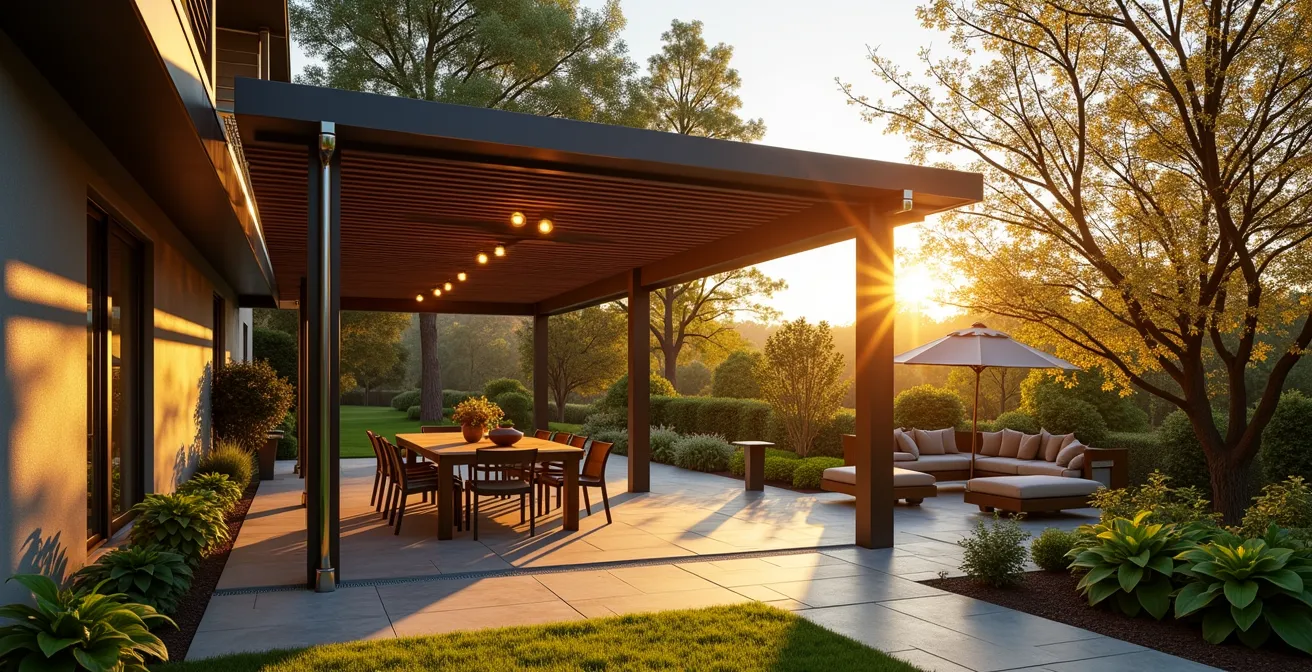
As shown in this image, a well-designed pergola can even integrate a rainwater harvesting system, intelligently directing it toward your shade garden beds, creating a virtuous cycle. The choice therefore depends on your budget, but above all on your desire for a four-season solution.
To help you visualize the pros and cons of each solution in a Canadian context, here is a comparative analysis.
| Criterion | Shade Sail | Louvered Pergola |
|---|---|---|
| 4-Season Adaptation | Mandatory removal in winter | Spring/fall use possible |
| Snow Management | Removal necessary | Designed according to Building Code standards |
| Usage Period | 3-4 months (summer) | 6 months (April to October) |
| Low Sun Capture | No | Yes (adjustable slats) |
| Initial Cost | Low | High |
| Rainwater Recovery | No | Possible with integrated system |
The mistake of trying to grow tomatoes with less than 6 hours of sun that leads to failure
One of the most frequent and discouraging mistakes is insisting on growing sun-loving vegetable plants, like tomatoes or peppers, in a shaded corner. These “fruiting” plants require a minimum of 6 to 8 hours of direct sun for photosynthesis, a process essential for producing the sugars that give flavorful fruit. In the shade, they stretch out, become vulnerable to disease, and produce little to no harvest. It is a battle lost in advance against plant biology.
The understory specialist landscape architect’s approach consists of embracing the constraint and transforming it into an opportunity for discovery. Instead of struggling, why not explore the fascinating world of shade edibles? Canada is full of native and adapted species that thrive in these conditions and offer unique flavors. It’s about a paradigm shift: from a traditional vegetable garden to a forest foraging garden. Specialized nurseries, like those found in Quebec and Ontario, are gold mines for these botanical treasures.
Give up the tomatoes and let yourself be surprised by a new and exciting harvest:
- Small fruits: Edible honeysuckle (Lonicera caerulea or Haskap) offers sweet, antioxidant-rich berries in early summer, while serviceberries (Amelanchier) and currants tolerate partial shade well.
- Leafy greens and herbs: Red-veined sorrel (Rumex sanguineus) is as beautiful as it is good in salads, and classics like mint and lemon balm flourish in the shade.
- Forest delicacies: Fiddleheads (ostrich fern heads from Matteuccia struthiopteris) are a typically Canadian spring treat. You can even start cultivating gourmet mushrooms like oyster mushrooms on logs or wood chips.
Why fighting moss in the shade is useless and what to replace it with advantageously?
The war against moss in shaded and damp areas is another exhausting and often futile battle. Moss is not the cause of your lawn’s poor health; it is the symptom. It appears where grass, which needs sun, cannot survive. Attempting to eradicate it with chemicals or rakes is a temporary solution because the conditions that favor its growth (shade, moisture, compacted and acidic soil) will remain. Moss will return because it is perfectly adapted to this environment.
What if, instead of fighting it, you welcomed it? A moss carpet is of subtle beauty, soft under bare feet, and requires no mowing. It is a near-zero-maintenance groundcover. To go further, you can orchestrate a true canvas of textures by completely replacing the failing grass with a mosaic of native Canadian groundcovers that thrive in the shade. These plants will form a dense green carpet, preventing weeds from settling in and offering visual interest throughout the year.
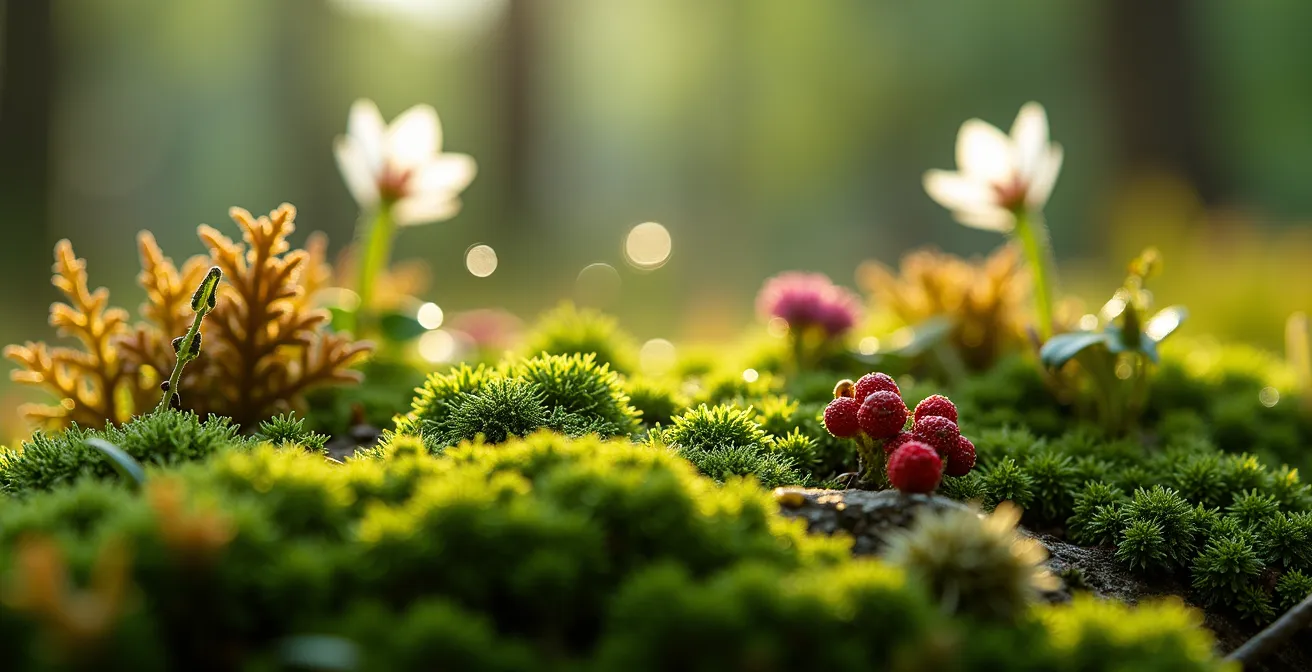
Imagine a living carpet, changing through the seasons, composed of these botanical wonders:
- Cornus canadensis (Bunchberry), with its white flowers in spring and red berries in summer.
- Tiarella cordifolia (Foamflower), which displays delicate, frothy flower spikes.
- Waldsteinia fragarioides (Barren Strawberry), which forms a dense, evergreen carpet punctuated by small yellow flowers.
- Trillium grandiflorum (White Trillium), Ontario’s floral emblem, for a spectacular spring touch.
- Evergreen ferns like the rock polypody (Polypodium virginianum) to maintain a green structure even in winter.
How landscaping a shaded area can reduce the felt temperature by 5 to 8 degrees?
In a context of global warming and increasingly frequent summer heatwaves in Canada, a shade garden is no longer just an aesthetic feature: it is a genuine cooling island—a natural and free air conditioner. While mineral surfaces like asphalt or concrete store heat and release it, vegetation actively cools the air through a process called evapotranspiration. Plant leaves release water vapor into the atmosphere, a phenomenon that consumes energy and lowers the ambient temperature.
The effect is far from anecdotal. Studies have shown that a well-vegetated area can be 5 to 8 degrees Celsius cooler than an adjacent area in full sun. The extent of this cooling is directly related to leaf mass. A large mature tree is a powerful air conditioner, but even a dense bed of perennials contributes significantly. In fact, some research on evapotranspiration shows that a single mature giant hosta can transpire up to 20 liters of water per day during a hot period.
Landscaping your shaded corner is therefore an investment in your summer comfort. By encouraging lush and layered vegetation (groundcovers, perennials, shrubs), you maximize the leaf surface area and, consequently, the cooling power of your garden. You create a sanctuary of freshness where you can take refuge during the hottest days—an invaluable advantage that sun-drenched garden owners will envy.
Why planting citronella is often insufficient to repel mosquitoes in Canada?
The myth of potted citronella as a mosquito shield dies hard. While citronella essential oil does have a repellent effect, the plant itself (Cymbopogon) does not release enough oil into the air to keep mosquitoes away from your deck. Furthermore, this tropical plant does not survive Canadian winters, making it an unsustainable solution. Research confirms that the repellent effectiveness of potted citronella is close to zero, whereas integrated management can reach 85% effectiveness.
The real solution, especially in a shade garden that is often more humid, is an integrated strategy that targets the mosquito’s life cycle. The goal is to reduce breeding sites and encourage natural predators. A well-designed shade garden becomes an ally in this struggle, rather than a breeding ground.
Here is a multi-pronged approach, expert-approved and adapted to our reality:
- Eliminate standing water: The first step is to hunt down every single saucer, clogged gutter, or tarp where water might accumulate. For larger water points like rain barrels, use biological larvicides based on BTI (Bacillus thuringiensis israelensis), a safe product approved by Health Canada.
- Encourage predators: Install native aquatic plants in your pond to attract dragonflies, whose larvae are heavy consumers of mosquito larvae. Grow nectar-rich plants like Spotted Joe-Pye Weed to attract insectivorous birds.
- Improve drainage: In very damp areas, plant “water pump plants” like Blue Flag Iris (Iris versicolor) which help dry the soil.
The trap of designing a glass-enclosed area without providing adequate ventilation for July
A large bay window or a sunroom overlooking a garden may seem like a wonderful idea, but if poorly designed, it can turn into a furnace during the first hot days of July. The greenhouse effect can make the interior space unbearable, depriving you of the view you so wished to enjoy. This is where the shade garden becomes an essential architectural partner—a living and elegant solution to the overheating problem.
Shade doesn’t limit your garden; rather, it offers the opportunity to create a lush, colorful space. By strategically positioning your shade garden in front of these glass surfaces, you create a “living painting” that fulfills several functions. It provides a magnificent view from the inside, gives an impression of freshness, and, most importantly, blocks direct solar radiation before it reaches the glass, thus passively reducing the interior temperature.
To compose this interior-visible painting, play with shapes, colors, and light:
- Create foliage contrasts: Combine hostas with white or cream variegated foliage, heucheras in purple tones, and ferns with feathery textures for a depth effect.
- Add points of light: Integrate white blooms that glow in the shade, such as those of ‘Annabelle’ hydrangeas, foxgloves, or white astilbes.
- Plant for the future: A fast-growing serviceberry planted a few meters from the window will provide welcome shade in 3 to 5 years, while offering flowers in spring and fruit in summer.
- Install landscape lighting: Warm white LED lights (2700K) directed downward onto the vegetation will create a magical and soft scene in the evening, extending the show.
Key Takeaways
- A successful shade garden is an ecosystem, not just a collection of plants. The key is to work with nature, not against it.
- For the Canadian climate, success depends on choosing native species and structures (like pergolas) adapted to our four seasons.
- Valuing shade allows for the creation of cooling sanctuaries, naturally reduces pests like mosquitoes, and increases summer living comfort.
How to enjoy your yard in the evening without being eaten alive by mosquitoes?
After orchestrating your botanical symphony, it’s time to enjoy it, especially during mild Canadian summer evenings. However, this is often when mosquitoes crash the party. Beyond the larval management we’ve seen, there is a “toolbox” of immediate solutions to create a bubble of comfort and enjoy your nocturnal sanctuary without being devoured.
The strategy relies on a combination of effective personal repellents, proven technologies, and smart lighting. The goal is not to eradicate every mosquito, but to create living areas so comfortable that they won’t bother you. Lighting, for example, should not only be functional; it should be inviting, soft, and designed to orchestrate shadows and light to highlight your landscaping without attracting unwanted insects.
Here is your arsenal for peaceful evenings:
- Use the right repellents: Forget ineffective gadgets. Rely on products whose efficacy is proven and Health Canada-approved. Repellents containing icaridin are an excellent alternative to DEET—just as effective and more pleasant on the skin.
- Create protection zones: Thermacell devices, which diffuse a repellent within a defined perimeter, are extremely effective for protecting a seating area like a patio or lounge corner. Their effectiveness has been tested and validated by thousands of Canadians, from Mauricie to Calgary.
- Light smartly: Install warm white LED landscape lighting (around 2700K). This light is much less attractive to insects than cool white light. Direct beams downward onto vegetation for indirect lighting that minimizes attraction.
- Keep the air moving: Mosquitoes are poor flyers. A simple, discreet outdoor fan can be enough to create a breeze that keeps them away from your dining or relaxation area.
To begin orchestrating your own botanical symphony, the first step is to observe your space carefully: analyze the nature of your soil, sun exposure hours, and moisture patterns to choose the plant palette that will transform your shaded corner into a living masterpiece.