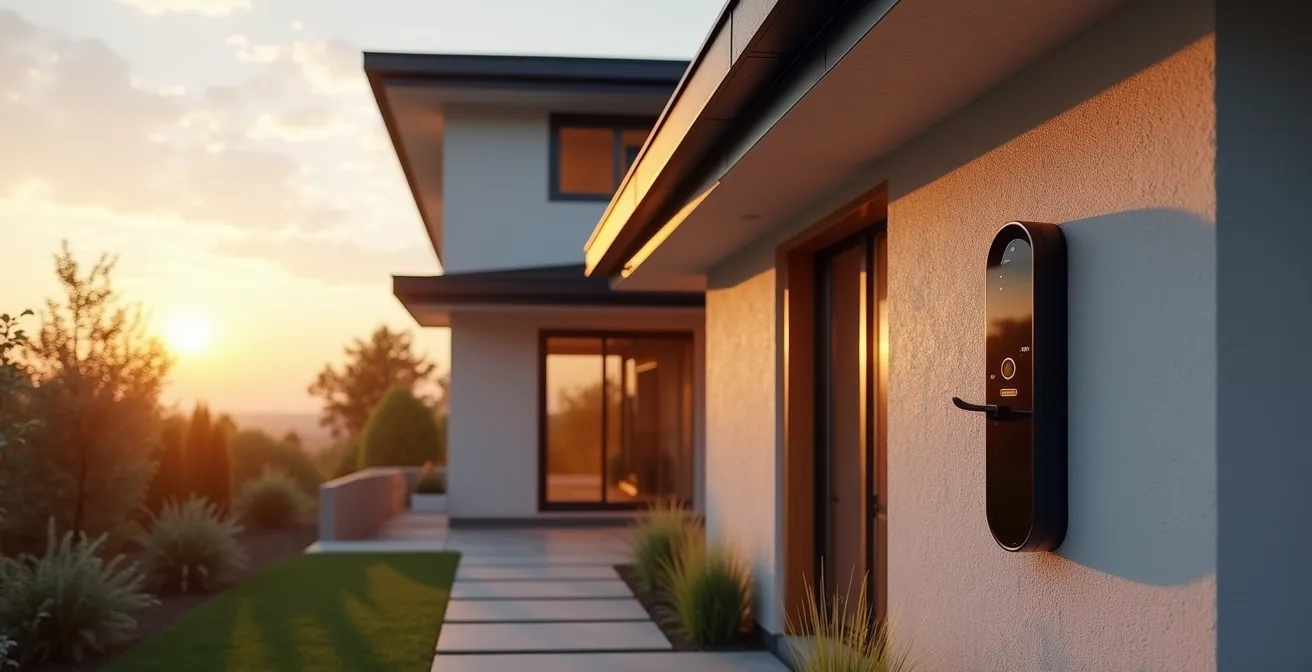
True home security doesn’t lie in a single piece of equipment, but in eliminating the “weakest link” in your defense chain.
- An intruder is an opportunist: they don’t look for a challenge, but for ease. A $500 lock on a fragile door frame is an invitation.
- Deterrence is an ecosystem: lighting, landscaping, and technology must work together to signal risk and eliminate blind spots.
Recommendation: Before investing, audit your access points by thinking like a burglar. This guide shows you where to look first.
The fear of intrusion hangs over many urban neighborhoods in Canada. Faced with this concern, the first reflex is often to turn to obvious solutions: sophisticated alarm systems, high-definition cameras, or state-of-the-art smart locks. These technologies have their place, but they are only the tip of the iceberg and treat the problem reactively rather than preventively. Too often, we invest heavily in a safe while leaving the key under the doormat.
Home security is not an arms race. It is an exercise in strategy. The fundamental question isn’t “How can I stop a determined intruder?” but rather “How can I convince an opportunistic intruder that my house is a bad target?” The answer lies in a systemic approach that views your property as a security chain. A burglar won’t test the strength of every link; they will exploit the weakest one—the one that gives way quickly and quietly. The robustness of your reinforced door is nullified by a poorly protected basement window.
This article moves away from the traditional security shopping list to arm you with a new perspective. We will deconstruct the opportunist’s mindset and analyze the breaking points they actively look for. By examining every layer of your defense—from the lock to the frame that supports it, from lighting to the psychology of deterrence—you will learn to identify and strengthen these weak links. The goal is not to turn your home into a fortress, but to make it strategically inhospitable to anyone with bad intentions.
To guide you through this proactive approach, we will examine the key nerve centers of residential security in detail. This structured overview will allow you to methodically audit your own home and make informed decisions adapted to the Canadian context.
Summary: The Complete Guide to Effective Home Deterrence
- Wi-Fi lock vs. keypad: which option is safer against hacking and picking?
- Why changing the lock is useless if your wooden door frame gives way at the first kick?
- Where to place your floodlights to surprise intruders without lighting up the neighbor’s bedroom?
- Bars or security film: how to protect vulnerable ground-level access points?
- Do alarm system stickers actually work if you don’t have a system?
- How can home automation compensate for loss of mobility and vision?
- Tempered glass or aluminum bars: which railing maximizes the view while keeping children safe?
- How to set up an effective camera system to monitor your cottage or home?
Wi-Fi lock vs. keypad: which option is safer against hacking and picking?
Choosing a smart lock isn’t just a matter of technological preference. It’s a trade-off between connectivity and robustness, especially in the Canadian context. Wi-Fi locks offer unparalleled remote control via apps, integrating perfectly into ecosystems like Bell or Telus. They allow you to check the door status from your office or grant temporary access to a visitor. However, this connectivity represents a digital attack surface. A poorly secured Wi-Fi network can become a gateway for hacking.
Conversely, keypad locks (without Wi-Fi) operate in a closed circuit. The risk of remote hacking is virtually zero. Their strength lies in reliability and simplicity. As shown by the experience of rental cottage owners in Quebec, models like Schlage or Igloohome are popular for managing access via temporary codes—an ideal solution in remote areas where internet connections can be unstable. Their battery life is also a significant advantage, often exceeding that of Wi-Fi models. Fortunately, most models, whether Wi-Fi or keypad-based, include a physical emergency key, an essential precaution.
Cold resistance is a decisive criterion in Canada. It is imperative to choose a model certified for our winters. Generally speaking, modern smart locks are designed to withstand temperatures as low as -30°C and even beyond, but performance can vary.
The following table highlights the fundamental differences to help you make an informed decision based on your priorities and environment.
| Criterion | Wi-Fi Lock | Keypad Lock |
|---|---|---|
| Cold Resistance | -30°C to 70°C (IP53 certification) | -35°C to 50°C (Schlage) |
| Battery Life | 4-6 months | 8-12 months |
| Smart Home Compatibility | Telus, Bell, Alexa, Google | Limited or requires bridge |
| Hacking Risk | Medium (depends on encryption) | Low (no connection) |
| Emergency Key | Yes, recommended | Yes, always included |
Why changing the lock is useless if your wooden door frame gives way at the first kick?
This is where the concept of the “weakest link” truly makes sense. You can install a bank-grade lock, but if it is attached to a weakened wooden door frame or with screws that are too short, it serves no purpose. An opportunistic intruder won’t attack the hardened steel cylinder; they will apply brute force to the frame, which will splinter in seconds. This is the most common break-in method—fast, loud, but terribly effective.
The wood in door frames, particularly in older Canadian homes, undergoes freeze-thaw cycles. It contracts, expands, and can develop cracks that compromise its structural integrity. Most builders, for the sake of economy, use strike plate and hinge screws barely an inch long, which only anchor into the casing and not the solid wall stud. This is a major systemic vulnerability that few homeowners consider.
Reinforcing the door frame is one of the most cost-effective security upgrades you can undertake. It involves transforming the door-frame-wall assembly into a single solid unit capable of dispersing the force of an impact. It is a straightforward operation that neutralizes forced entry techniques.
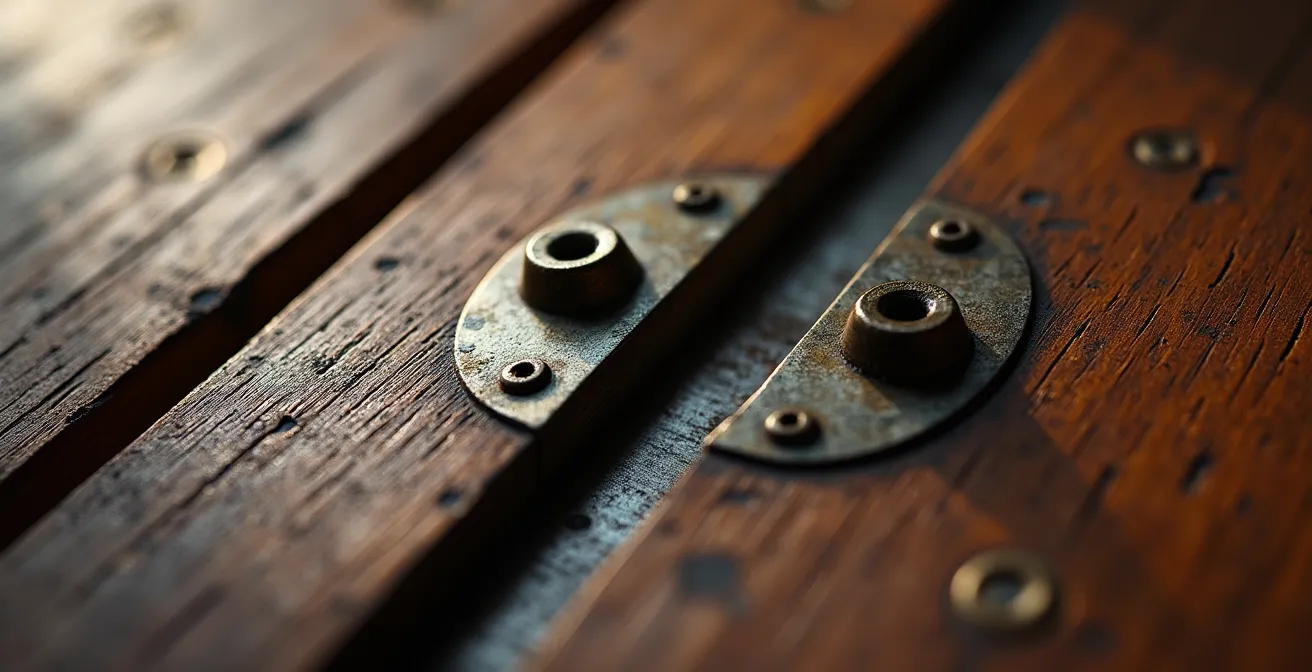
As shown in this image, reinforcement involves adding metal components that secure the door and its frame to the house’s structure. To do this, several simple but crucial actions should be considered:
- Replace hinge screws: Remove existing screws and replace them with 3-inch wood screws. They will pass through the frame to anchor solidly into the wall stud.
- Install a reinforcement plate: Also known as an extended strike plate, this long metal plate replaces the standard small strike plate. Secured with long screws, it distributes pressure across the entire height of the frame. You can find these at Rona or Home Depot.
- Add a door shield: This steel accessory fits around the deadbolt and handle to prevent the door wood itself from splitting under impact.
Where to place your floodlights to surprise intruders without lighting up the neighbor’s bedroom?
Security lighting is not intended to illuminate your property like a football field. Its primary role is psychological deterrence. An intruder operates under the cover of shadow. The goal is to rob them of this advantage by creating “zones of discomfort” where they feel exposed and visible. A sudden, harsh light is a powerful warning signal that prompts them to flee.
A common mistake is placing a single high-powered floodlight that indiscriminately washes over your yard and your neighbor’s, creating deep new shadows in the process. An effective strategy, like that adopted by residents in Toronto’s Forest Hill neighborhood, relies on layered lighting: low-intensity ambient lighting that eliminates main shadow areas, coupled with motion-activated floodlights placed at strategic points.
Placement is more important than power. Here are the guiding principles for an effective and neighbor-friendly installation, in accordance with most Canadian municipal bylaws on light pollution:
- Downward orientation: Floodlights should be pointed toward the ground at an angle of about 45 degrees. This maximizes light in the target area while preventing light from escaping into the sky or onto your neighbors’ property.
- Strategic height: Place motion sensors about 2.5 meters high. This provides good detection range while making them harder to tamper with.
- Blind spot coverage: Identify likely access paths (driveways, sides of the house, back door) and ensure each area is covered. Think of “overlapping” detection zones rather than “juxtaposition.”
- Color temperature: For the alert effect, prioritize 4000K (cool white) LED bulbs. This light is perceived as more clinical and alarming than the warm white used for ambiance.
Before any installation, a quick consultation of your municipality’s website is necessary. Many cities in Canada have strict regulations to limit light pollution. Respecting these rules is not just an act of being a good neighbor; it’s also ensuring your security system isn’t challenged legally.
Bars or security film: how to protect vulnerable ground-level access points?
Ground-floor doors and windows, particularly sliding ones or those at the back of the property, are prime targets. They are often less visible from the street and perceived as easier to force. Indeed, according to burglary statistics, more than 51.7% of forced entries occur through patio doors. Securing them is a top priority, but the solution shouldn’t turn your home into a prison.
Wrought iron bars offer a formidable physical barrier. They are a clear and unambiguous message of deterrence. However, they can be aesthetically heavy and, more importantly, pose a fire hazard if not equipped with an interior quick-release mechanism. The National Building Code of Canada requires an escape route in every bedroom, making this feature non-negotiable for bedroom windows.
A more modern and discreet alternative is security film. This transparent membrane, applied to the inner face of the glass, holds the glass in place even when broken. It doesn’t prevent it from breaking, but it significantly delays entry, forcing the intruder to make noise and waste precious time. A burglar expecting to shatter a window in one hit finds themselves having to strike repeatedly, drastically increasing the risk of being spotted. As a bonus, these films often offer thermal insulation and UV protection, a valuable benefit during Canadian winters and summers.
The best strategy often combines several approaches. Installing security film can be complemented by defensive landscaping, such as planting thorny shrubs (Berberis, rugosa roses) under vulnerable windows. This natural and aesthetic obstacle makes approaching the window difficult and uncomfortable. For maximum security, the film can be paired with glass-break sensors connected to an alarm system, creating a defense-in-depth: physical, natural, and electronic.
Do alarm system stickers actually work if you don’t have a system?
This is a question of psychology rather than technology. The short answer is yes, but with important nuances. A sticker displaying the logo of a well-known security company is a form of visual deterrence. For an opportunistic intruder evaluating multiple targets on a street, a house announcing active protection represents a complication—an extra risk. Between a house displaying a security system and one showing nothing, their choice will almost always fall on the latter.
The effectiveness of this tactic relies entirely on credibility. A faded, poorly positioned, or generic sticker will have little impact. For the bluff to work, it must be convincing. Use high-quality stickers and signs identical to those provided by real alarm companies. Place them visibly at main entry points: front door, rear patio doors, accessible windows.
Research on the effectiveness of visual deterrence in Canadian neighborhoods confirms this. Neighborhood watch initiatives in Toronto, where residents display signs signaling their participation, have shown a notable reduction in intrusion attempts. The message sent is that of a vigilant and organized community, which is a powerful deterrent. The sticker works on the same principle: it signals that the owner is aware of risks and has taken action. Whether those actions are real or simulated is information the intruder has neither the time nor the inclination to verify.
However, one shouldn’t rely solely on this trick. A more experienced burglar might recognize a bluff or simply decide to take the risk. The sticker should be considered the first and thinnest layer of your security system. It must be integrated into a broader strategy including good lighting, solid locks, and reinforced frames. It is a low-cost tool with high potential, but it does not replace real physical protection.
How can home automation compensate for loss of mobility and vision?
For seniors or individuals with reduced mobility, home automation is not a gadget but a genuine tool for autonomy and safety. It acts as an extension of their senses and ability to act, allowing them to monitor and control their environment without having to move. Technology becomes a vigilant guardian that compensates for physical vulnerabilities.
One of the greatest benefits is access management. A smart video doorbell is much more than a simple intercom. Paired with a device like Google Chromecast or Apple TV, it can automatically display the video feed on the television screen as soon as a visitor rings. The person can clearly identify who is at the door from their armchair. If they recognize the visitor, they can unlock the door remotely via voice command or an app, eliminating the need to rush.
Automated lighting and locks also play a crucial role. Here are some simple configurations to set up with assistants like Alexa or Google Home:
- Automatic locking: Program all smart locks to lock automatically at a set time in the evening, for example, 9:00 PM. A voice notification (“All doors are now locked”) can confirm the house is secure.
- Night light path: Motion sensors can be configured to turn on low-intensity lights at night, creating a safe path to the bathroom and reducing the risk of falls, while also serving as an alert in case of unexpected movement.
- “Panic” scenario: A simple voice command (“Alexa, activate panic mode”) can trigger a predefined scenario: turning on all lights at 100%, sounding a siren, and sending a notification or calling an emergency contact.
Despite these advancements, the Canadian context requires staying pragmatic. A study on the adoption of smart locks by Quebec seniors showed that while Weiser Premis fingerprint readers are appreciated for their simplicity, their touchpads can become less responsive in extreme cold. The solution often lies in redundancy: a system that combines fingerprint, code, and physical key offers the best guarantee of operation in any season.
Tempered glass or aluminum bars: which railing maximizes the view while keeping children safe?
Choosing a railing for a balcony or terrace is a complex trade-off between safety, aesthetics, and compliance with the Building Code. The goal is twofold: to prevent falls, especially of young children, and not to create a new vulnerability by offering easy handholds for an intruder. All this while preserving the view, a major asset for many properties.
Tempered glass railings are the preferred solution for an uninterrupted panoramic view. Their smooth, continuous surface is extremely difficult to climb, whether for a child or an intruder. They offer very effective passive security. Their main drawback lies in maintenance, particularly during Canadian winters. Snow, frost, and splashes can quickly dirty the panels, requiring regular cleaning to maintain transparency.
Aluminum railings, on the other hand, require virtually no maintenance. They are lightweight, durable, and perfectly weather-resistant. However, their design directly impacts safety. Models with vertical bars are an excellent choice: they preserve a good portion of the view and offer no climbing holds. Conversely, horizontal bar models, though very trendy, should be avoided. They create a literal ladder, both for a curious child and an agile burglar. They are actually non-compliant in many municipalities for this reason.
The table below, based on National Building Code of Canada criteria, summarizes key points to guide your choice, including the evaluation of anti-intrusion security and ease of maintenance, as shown by a recent comparative analysis.
| Material | Anti-intrusion Security | Winter Maintenance | Panoramic View |
|---|---|---|---|
| Tempered Glass | Difficult to climb | Regular cleaning (snow/frost) | Maximal |
| Vertical Aluminum | No maintenance | None | Good |
| Horizontal Aluminum | Provides holds | None | Average |
| Glass/Alu Hybrid | Optimal | Moderate | Very Good |
The hybrid solution, combining aluminum posts with glass panels, often represents the best compromise. It combines the robustness and low maintenance of aluminum with the transparency and security of glass, while creating a modern and elegant design.
Key Takeaways
- Think “security chain”: identify and reinforce the weakest link in your home, as that is what the intruder will target.
- The best security is deterrence: your goal is to convince the opportunist that your home is too complicated or risky a target.
- Adapt every solution to the Canadian context: cold resistance, build quality, and local regulations are decisive factors.
How to set up an effective camera system to monitor your cottage or home?
Installing surveillance cameras isn’t about placing as many as possible. It’s about creating a strategic vigilance network that covers critical points without blind spots. For a primary residence, the goal is deterrence and verification. For a remote cottage, the stakes are different: it’s about remote monitoring and early detection in an environment where help might be far away. This distinction is crucial, especially since data shows that crime rates in rural areas are sometimes higher than in urban zones.
An effective system is a layered system. The first layer is visible deterrence: a prominent camera near the main entrance signaling that the property is under surveillance. This camera should have a wide field of view to cover the driveway and door. Subsequent layers are more discreet and aimed at detection and identification. They cover other access points: back door, patio doors, basement access.
For a cottage, the strategy must be even more robust and autonomous. Power and internet connections aren’t always reliable. This is where specific solutions come in, such as autonomous battery-powered trail cams camouflaged on forest paths, or 4G/LTE cameras powered by solar panels to monitor a dock or shed. Cold resistance is a non-negotiable criterion here, with models certified to operate down to -40°C.
Finally, the issue of image storage is paramount, especially regarding Canadian legislation on personal information protection (PIPEDA). Purely local storage on an SD card is risky: if the burglar steals the camera, you lose the evidence. 100% cloud storage can be expensive and dependent on connection. The ideal solution is often hybrid storage: continuous recording on a local SD card and sending motion alerts to a cloud service hosted in Canada.
Action Plan: Your Camera Placement Strategy for a Cottage
- Main contact point: Position a camera with a 180° view at the main entrance to detect anyone or any vehicle approaching.
- Secondary access: Install autonomous, camouflaged trail cams on paths or forest access points leading to the property.
- Outbuildings: Monitor the shed, garage, or dock with autonomous 4G/LTE cameras paired with a small solar panel.
- Sensitive points: Protect high-value items like a propane tank or a generator with an infrared camera certified to operate down to -40°C.
- Storage and compliance: Set up hybrid storage: an SD card in each camera for continuous local recording and a subscription to a Canada-based cloud service for backing up alerts and ensuring PIPEDA compliance.
Home security is not a product you buy, but a discipline you practice. By adopting this “security chain” mindset and learning to think like an opportunist, you transform how you look at your own home. Every door, every window, every dark corner becomes a question—an opportunity for improvement. This proactive and systemic approach is infinitely more powerful than accumulating gadgets. To apply this method, start now by auditing your entry points and asking yourself: “Where is my weakest link?”.