Summary:
- The secret to a comfortable wake-up isn’t heating harder, but anticipating your home’s thermal inertia.
- Adjusting your thermostat’s cycle (the duration and frequency of heating periods) is as crucial as setting the temperature.
- The type of schedule (daily, 5+2 days, smart) should be chosen based on the actual regularity of your lifestyle.
- Smartly managing unoccupied rooms and the temperature during winter vacations allows for substantial savings without sacrificing comfort upon return.
The scenario is sadly familiar for many Canadians: the alarm rings, and the first sensation is an icy air that grabs you as soon as you step out from under the covers. You have a programmable thermostat, you followed the basic advice to lower the temperature at night, but nothing seems to work. The house seems to take an eternity to warm up, turning every winter morning into a minor ordeal. We often think the solution is to buy a more expensive model or push the heating to the maximum—strategies that are costly and often ineffective.
Most guides settle for telling you to program the temperature rise 30 minutes before you wake up. This is a cliché that ignores a fundamental reality: every house is unique. Its insulation, sun exposure, and the type of heating system create what is called specific thermal inertia. But what if the real key wasn’t simply programming a time, but understanding and mastering this inertia so that your heating system works for you, not against you?
This article proposes a different approach. Instead of repeating the same generic advice, we will dive into the fine mechanics of thermal comfort. It’s not just about setting a temperature, but about orchestrating a symphony between your thermostat, the rhythm of your life, and the characteristics of your home. We will see how a simple adjustment can eliminate annoying clicks, which program is truly made for your unpredictable daily life, and how unexpected elements like your bedding or lighting contribute to your morning well-being.
For those who prefer an overview of modern technologies, the following video illustrates how connected thermostats allow you to control your comfort at your fingertips—one of the solutions for applying the principles we will discuss.
To guide you toward optimal and sustainable morning comfort, this article is structured to progressively answer all your questions. You will discover concrete strategies and clear explanations to transform your relationship with your heating system.
Table of Contents: Mastering Thermal Comfort for Perfect Mornings
- Why does your thermostat “click” all the time and how to adjust the sensitivity?
- Weekday/weekend or daily schedule: which one suits your irregular lifestyle?
- Should you turn off the heat in guest rooms or just lower it to 15°C?
- The mistake of lowering the heating too low during your winter vacation
- Touchscreen or physical buttons: which model is more durable and easier for seniors?
- Cooling gel or natural latex: which material to choose if you are always too hot at night?
- Why is underfloor heating better for allergy sufferers than electric baseboards?
- How smart lighting can improve your mood and sleep in winter?
Why does your thermostat “click” all the time and how to adjust the sensitivity?
This incessant “clicking” is often a symptom of a thermostat that is working too hard, or incorrectly. It signals the start and end of a heating cycle. Cycles that are too short and frequent not only wear out your system prematurely but also create uncomfortable temperature variations. Before thinking of a defect, you must understand that this behavior is often linked to a sensitivity setting, also called “span” or “differential.” A setting that is too fine forces the system to react to the slightest 0.1°C variation, hence the constant clicks. Properly adjusting this parameter is the first step toward comfort and savings. Indeed, according to Hydro-Québec, optimized management with electronic thermostats can save more than $100 per year on heating bills.
However, it is necessary to distinguish this functional click from metallic expansion noises—those “pings” and “pongs” coming from the baseboards themselves. As explained in an Écohabitation guide, these noises are often caused by a slightly deformed installation that prevents the metal from expanding freely. Simply tightening or loosening the screws securing the baseboard to the wall can often solve this acoustic problem without touching the thermostat.
The key is therefore to adjust the duration of the cycles. A longer cycle allows for a gentler temperature rise and more stable heat. For electric baseboards, a 15-minute cycle is a good starting point, while a heated floor, with its high thermal inertia, will require longer cycles, from 20 to 30 minutes, to diffuse homogeneous heat. The goal is to find the balance where the thermostat maintains comfort without activating frantically.
Action Plan: Adjusting your thermostat’s cycle
- Identify the load type: Determine if your thermostat controls electric baseboards, convectors, a forced-air system, or a heated floor. This information is crucial.
- Access advanced settings: Consult your thermostat’s manual to find out how to enter the configuration menu (this often involves pressing several buttons simultaneously).
- Select the right cycle: For baseboards or convectors, choose a 15-minute cycle. For a heated floor, opt for a longer cycle of 20 to 30 minutes for more stable heat.
- Check contraindications: Never use the forced-air system setting (very short 15-second cycles) with baseboards, unless you have an electronic solid-state relay (SSR).
- Test and adjust: After the adjustment, observe your system’s behavior for 24 hours. If comfort is not optimal, adjust the cycle duration in small increments.
Weekday/weekend or daily schedule: which one suits your irregular lifestyle?
Owning a programmable thermostat is one thing, but using it to its full potential is another. In Canada, while nearly 63% of Canadian households are equipped with a programmable model, many settle for the factory setting or a schedule that no longer matches their reality. Between remote work, staggered shifts, and children’s activities, the classic “weekday/weekend” (5+2) program is no longer suitable for many families. Choosing the right type of programming is essential for combining personalized comfort with energy savings.
The 7-day (or daily) program offers maximum flexibility. It allows you to set a different schedule for each day of the week. It’s ideal if your remote-work Tuesdays don’t look like your office Thursdays, or if hockey practices constantly change the routine. The simpler 5+2 program suits people with a very regular lifestyle, with fixed departure and return times from Monday to Friday. Finally, the smart thermostat represents the ultimate solution for unpredictable lives. It learns your habits, geolocates via your phone to know when you leave the house or are about to return, and adjusts the heating accordingly. It’s the end of the programming headache.
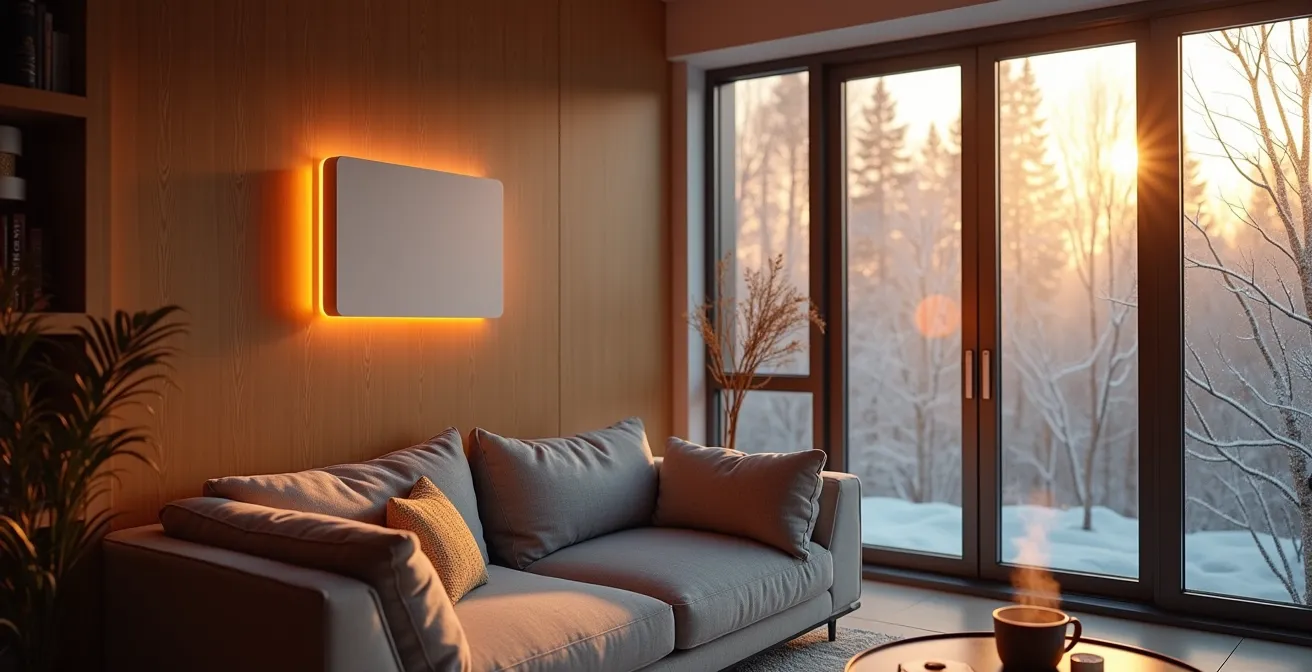
The image below perfectly illustrates the ultimate goal of good programming: coming home to a welcoming and warm house, regardless of the whims of the weather or your schedule.

This feeling of immediate comfort is not a luxury, but the result of an intelligent anticipation of your needs. The following table, inspired by analyses from publications like Protégez-Vous, will help you visualize which option is most relevant for your home.
| Thermostat Type | Ideal Profile | Average Savings | Average Cost (CAD) |
|---|---|---|---|
| 7-day programmable | Hybrid worker with variable schedule | 10-15% | $100-200 |
| 5+2 days | Fixed weekday/weekend schedule | 5-10% | $50-150 |
| Smart/Connected | Hockey parent, unpredictable schedules | Up to 20% | $150-350 |
Should you turn off the heat in guest rooms or just lower it to 15°C?
Managing unoccupied rooms, such as a guest room or a rarely used office, is a common dilemma. The first instinct is often to close the door and completely cut off the heat in that area to maximize savings. However, this approach can be counterproductive, especially in the harsh Canadian winter climate. Completely cutting off heat in a room creates a “cold spot” in the house. The walls of that room become cold and “suck” the heat from adjacent rooms, forcing the main heating system to work harder to maintain comfort elsewhere. Additionally, a total absence of heating drastically increases the risk of condensation on exterior walls and windows, promoting the appearance of mold.
The most effective strategy is what could be called smart thermal zoning. Rather than cutting it off, it is better to significantly lower the temperature. A setpoint around 15°C or 16°C is ideal. This temperature is low enough to generate substantial energy savings, yet high enough to prevent condensation and the freezing of pipes that might pass through the walls. This maintains a base temperature that reduces the thermal shock for the rest of the house. When you have guests, you just need to anticipate their arrival by a few hours to raise the temperature to a comfort level (generally 20-21°C), without your system having to provide an excessive effort.
For nighttime comfort in occupied bedrooms, the ideal temperature is generally around 18°C. A cooler room promotes better quality sleep. Programming a decrease to this temperature one hour before bed and a rise to 20°C about 30 minutes before waking up is an excellent programming baseline for primary bedrooms.
The mistake of lowering the heating too low during your winter vacation
Going on a winter vacation is the perfect opportunity to save on heating. The most frequent and costly mistake is lowering the thermostat to an extremely low temperature, such as 10°C or even 5°C, thinking it will maximize savings. This is a bad calculation that completely ignores the concept of thermal inertia in your home. A house cooled to this point for several days accumulates a huge amount of “cold” in its walls, floors, and furniture. Upon your return, your heating system will have to run continuously for many long hours, or even days, to bring all this mass back to a comfort temperature. This overconsumption of energy can cancel out, and even exceed, the savings made during your absence.
The real danger, especially in Canada, is the risk of pipe freezing. Even if the air temperature is 5°C in the center of the room, near a poorly insulated exterior wall or in a crawl space, the temperature can easily drop below the freezing point. A burst pipe can cause thousands of dollars in water damage—a cost out of all proportion to the few dollars saved on the heating bill.
What then is the right strategy? As with guest rooms, moderation is key. Canadian experts and insurers recommend never setting your thermostat below 15°C or 16°C during a prolonged absence in winter. This base temperature prevents pipes from freezing and limits the accumulation of cold in the building’s mass. The temperature rise upon your return will be much faster and less energy-intensive. With a smart thermostat, you can even program the rise to 20°C a few hours before your arrival, so you find a comfortable home as soon as you step through the door.
Touchscreen or physical buttons: which model is more durable and easy for seniors?
In the quest for the perfect thermostat, the user interface is an often-underestimated yet crucial criterion, especially for seniors or those less comfortable with technology. The choice between a state-of-the-art touchscreen and a traditional physical button model depends on a trade-off between modernity, durability, and ease of use. Physical button models have proven their worth. Their advantages are clear: distinct tactile feedback (you feel the “click”), simple handling that doesn’t require navigating complex menus, and generally superior robustness. A button is a simple mechanical part, less prone to failure than a touchscreen sensitive to dust, humidity, or shocks.
For a senior, readability is paramount. The best models for this audience are those that combine large, well-spaced buttons with a large, high-contrast backlit screen. The display should clearly show the current temperature and the setpoint in large characters, without superfluous information. Programming, if it exists, should be intuitive, with clear actions like “Leave,” “Return,” “Night.”
Touchscreen thermostats, on the other hand, offer more features and a more modern aesthetic. They allow access to finer programming and consumption graphs. However, they can be intimidating. Navigating through submenus can be confusing, and screen sensitivity can be an issue for less agile fingers. In terms of durability, a touchscreen is potentially more fragile and more expensive to replace than a simple button. For an older audience, the simplicity and reliability of physical buttons often outweigh the sophistication of touchscreens.
Cooling gel or latex natural: which material to choose if you are always too hot at night?
Thermal comfort in a bedroom is not just about ambient air temperature. Even with a thermostat set to an ideal nighttime temperature of 18°C, many people suffer from excess heat during sleep. This phenomenon is often linked to bedding, which plays a major role in body temperature regulation. The choice of mattress and pillow is therefore an essential component of your overall comfort strategy. If you tend to run too hot, your thermostat isn’t the only culprit; your mattress may be trapping your body heat.
Two main technologies compete to solve this problem: cooling gel and natural latex. Mattresses and toppers made of memory foam infused with gel beads are designed to absorb body heat and dissipate it. The sensation of coolness is often immediate and highly appreciated when going to bed. However, throughout the night, the gel can reach a saturation point and lose some of its effectiveness. This is an excellent solution for those who have trouble falling asleep because of the heat.
Natural latex, on the other hand, offers a different approach. Its open-cell structure gives it exceptional breathability. Rather than absorbing heat, it allows air to circulate freely, thus evacuating heat and moisture throughout the night. It doesn’t provide the same initial “cold” sensation as gel, but it ensures more consistent and durable thermal regulation. For people who wake up sweating in the middle of the night, latex is often the best long-term option. The choice therefore depends on your need: instant coolness for falling asleep (gel) or continuous regulation all night long (latex).
Why is underfloor heating better for allergy sufferers than electric baseboards?
The type of heating system has a direct impact not only on the sensation of warmth but also on indoor air quality. For people suffering from allergies to dust, dust mites, or pollen, the choice between electric baseboards and underfloor heating can make a significant difference in their well-being. Electric baseboards, like most convection heating systems, work by heating the air nearby. This warm air, being lighter, rises to the ceiling, cools, and then sinks back to the floor, creating a continuous convection current in the room.
This constant air movement has the effect of stirring up and keeping allergens in suspension within the room: dust, pet hair, dust mites… This is why rooms heated by baseboards can sometimes seem “dustier” and worsen allergic symptoms. Furthermore, the high temperatures reached by baseboard elements can carbonize dust particles that settle on them, releasing odors and irritating compounds into the air.
Underfloor heating, conversely, is a radiant system. It doesn’t directly heat the air but warms the surface of the floor, which in turn radiates soft, homogeneous heat toward objects, walls, and people in the room. This mode of heat diffusion is much gentler and creates almost no air movement. Allergens stay on the floor and are not kicked up into the air, creating a much healthier indoor environment. Heat is also better distributed, without the cold zones at floor level and overheated zones near the ceiling typical of convection. For an allergy sufferer, investing in a heated floor translates to unparalleled respiratory comfort.
Key Takeaways
- Master the cycle: Comfort doesn’t just depend on temperature, but also on the frequency and duration of heating cycles. A setting adapted to your system (baseboards, heated floor) is essential.
- Program your life, not an ideal: Forget standard programs if your life is irregular. Opt for a 7-day or smart thermostat that adapts to your true rhythm.
- Think “thermal inertia”: A house stores cold. Avoid lowering the temperature too much during absences to prevent overconsuming energy upon return and risking frozen pipes.
How smart lighting can improve your mood and sleep in winter?
Morning comfort in winter doesn’t just depend on thermal sensation. The lack of natural light during dark Canadian mornings has a proven impact on our mood and energy. Waking up in complete darkness and then turning on a harsh light can be a shock to the system. The modern solution is to synchronize your thermal wake-up with a light-up alarm, thanks to smart lighting. This holistic approach to waking up completely transforms the morning experience.
The principle is to simulate a natural sunrise. Smart bulbs, programmed via an app, can start to turn on very dimly about 30 minutes before your wake-up time. The light then gradually increases in intensity and changes color, moving from a warm red-orange to a bright white light, mimicking the sun’s progression. This progressive light signal sends a message to your brain to reduce the production of melatonin (the sleep hormone) and increase cortisol (the wake-up hormone). The result is a much gentler and more natural wake-up.
The association of this light-up alarm with the programmed temperature rise of your thermostat creates a perfect synergy. By the time your eyes open, the room is already bathed in pleasant light and the ambient temperature is comfortable. This double sensory stimulation makes getting out of bed easier, improves mood, and helps regulate your circadian rhythm, which can have benefits on your sleep quality the following night. It’s the final touch to permanently banish the brutality of winter wake-ups.
Now that you understand the fine mechanisms governing thermal comfort, you hold the keys to radically transforming your mornings. By applying these strategies, you will move from passive and often frustrating management of your heating to active and intelligent control, perfectly adapted to your home and lifestyle. To turn this advice into lasting comfort, the next step is to audit your current system and apply the programming that truly fits your household’s needs.