The key to a stylish family home isn’t fighting the mess, but designing systems that elegantly absorb it.
- Materials aren’t everything: technical durability (like the Double Rubs rating) must guide your fabric choices.
- Smart design (organic shapes, multi-functional storage) prevents accidents and camouflages chaos effortlessly.
Recommendation: Adopt sensory zoning by using light and textures to define play areas—a strategy more effective than physical barriers.
The dream of an interior worthy of a decor magazine often seems incompatible with the reality of a busy family life. Between fingerprints on the walls, toys invading the living room, and dog hair embedded in the sofa, many Canadian parents eventually give up, relegating style in favor of a sometimes stark practicality. You are often advised to choose “resistant” materials and to tidy up constantly, but these surface solutions don’t tackle the root of the problem. They place you in a constant state of reaction to chaos, an exhausting and often losing battle.
What if the real solution wasn’t to resist the mess, but to anticipate and integrate it? A family designer’s approach isn’t to banish life, but to create invisible systems. It’s about making choices in materials, shapes, and layouts so intelligent that they anticipate and absorb the wear and tear and disorder of daily life. An elegant family home is not a home where people don’t live; it’s a home designed to be lived in, intensely and with style.
This guide offers a realistic and stylish approach, far from the clichés. We will explore how strategic decisions regarding coverings, furniture, and space organization can transform family constraints into a true design signature. You will discover how material science, environmental psychology, and a few pro tips can allow you to create an interior that is both beautiful, safe, and perfectly adapted to your joyful chaos.
This article is structured to guide you step-by-step, from choosing the highest-performing materials to the subtle art of space organization. The table of contents below gives you an overview of the strategies we will cover to reconcile aesthetics and family life.
Summary: Reconciling design and family life: the complete guide
- Leather or microfiber: which upholstery best resists cat claws and dog hair?
- How to integrate toy bins into the living room decor without it looking like a daycare?
- Round or oval: why choosing organic shapes is safer and improves traffic flow?
- Are washable rugs worth the price for high-traffic zones like the entryway or kitchen?
- Pearl or eggshell finish: which paint truly allows you to wipe away fingerprints without burnishing the wall?
- Basement playroom or living room play corner: which solution promotes child independence?
- What does the “Double Rubs” code mean and how many do you need for a family of 4?
- How to zone your home so that the kids’ mess doesn’t contaminate the adult space?
Leather or microfiber: which upholstery best resists cat claws and dog hair?
The sofa is often the first piece of furniture to suffer the assaults of family life. Choosing its upholstery is therefore a crucial strategic decision. The two most frequently mentioned options are leather and microfiber, but their performance against pets varies greatly. Genuine leather, thanks to its smooth surface, is exceptional for repelling hair, which can be removed with a simple wipe. It is also very resistant to superficial scratches, which can often be buffed out with a suitable product. However, a deep scratch will be permanent.
Microfiber, on the other hand, is a synthetic fabric with an extremely tight weave. This structure prevents claws from catching and pulling threads, making it an excellent choice against cats that like to “scratch.” Its ability to resist stains is often superior to that of untreated leather. Its main drawback is static electricity, which can turn your sofa into a hair magnet, requiring regular brushing or vacuuming. The choice therefore depends on your priority: ease of hair removal (leather) or resistance to snags (microfiber).
To visualize the trade-off between these two materials, the following table compares their key characteristics, taking into account the Canadian context, particularly regarding pricing.
| Criteria | Leather | Microfiber |
|---|---|---|
| Scratch resistance | Excellent (smooth surface) | Very good (tight weave) |
| Hair maintenance | Easy (no sticking) | Average (static electricity) |
| Stain resistance | Good with treatment | Excellent (water-repellent) |
| Average Price Canada | 2000-4000 CAD | 800-1500 CAD |
| Durability | 10-15 years | 7-10 years |
How to integrate toy bins into the living room decor without it looking like a daycare?
The biggest aesthetic challenge of a family living room is toy management. The common mistake is adding garish plastic bins that break the harmony of the decor. The designer’s solution consists of thinking of storage not as an addition, but as an integral part of the furniture. The goal is to create low storage friction: it must be easier and faster for a child (and for you) to tidy up than to leave things lying around.
To achieve this, prioritize multi-functional furniture. A large storage bench with a Scandinavian look can serve as extra seating while hiding a surprising amount of toys. An elegant storage ottoman can house stuffed animals and cushions. Low shelving systems, like the famous IKEA KALLAX, are perfect when equipped with fabric or wicker bins whose color and material echo those of your curtains or rugs. These neutral containers blend into the decor instead of visually polluting it. Finally, think about rotation: by leaving only a selection of toys accessible, you reduce the volume to be tidied and renew your children’s interest.
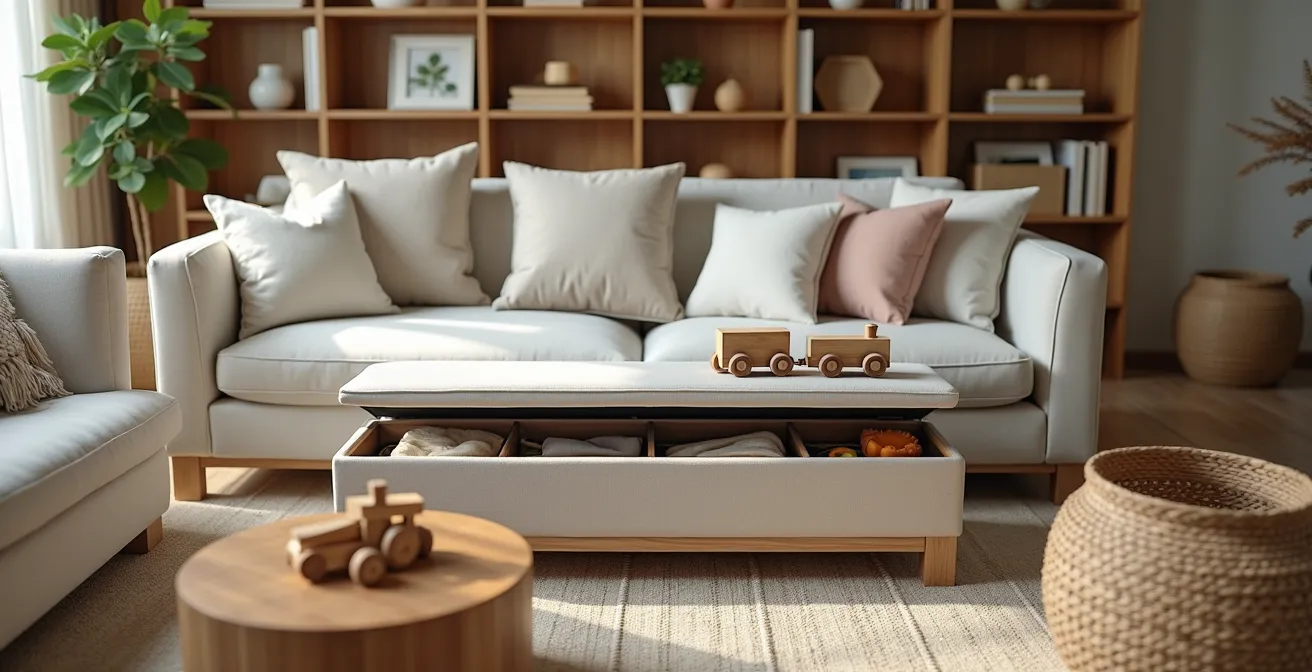
As shown in this image, successful integration relies on the harmony of materials and colors. Natural fiber baskets and light wood furniture create a visual continuity that makes storage almost invisible, transforming a simple toy bin into a decorative element in its own right.
Round or oval: why choosing organic shapes is safer and improves traffic flow?
In a home where children run and space is often shared, the sharp corners of rectangular furniture are real dangers. Choosing furniture with organic shapes—round coffee tables, oval dining tables, armchairs with soft curves—is primarily a matter of preventive safety. Rounded corners drastically reduce the risk of injury during falls and energetic play. It’s a design choice that brings invaluable peace of mind.
Beyond safety, organic shapes have a major psychological and functional impact. They create a more fluid and natural traffic flow in a room. Unlike a square table that imposes rigid paths, a round table invites people to move freely around it. In the open floor plans typical of modern Canadian condos and houses, where the living room, dining room, and kitchen are one, this fluidity is essential to prevent the space from feeling cluttered. As Quebec interior designer specialized in family spaces, Marie-Claude Bélanger, points out:
Round and organic shapes promote a sense of community and conviviality, naturally creating warmer gathering spaces for families.
– Marie-Claude Bélanger, Quebec interior designer specialized in family spaces
Case Study: Impact in Canadian Condos
A study conducted with Canadian families living in Toronto and Montreal condos revealed compelling results. The introduction of round tables and soft-curved furniture reduced minor corner-related incidents by 40% in living spaces under 80m². Participants also reported a sense of “enlarged” space and better conviviality, validating the impact of organic shapes on the perception and use of family space.
Are washable rugs worth the price for high-traffic zones like the entryway or kitchen?
The idea of a rug in an entryway or under the kitchen table might seem like heresy for a family with a dog and children. Yet, it’s in these zones that the comfort and visual delimitation of a rug are most appreciated. This is where machine-washable rugs come into play. Although their initial cost is higher than a standard rug, their value is measured over the long term. Rather than throwing away a soiled and worn rug every year, a high-quality washable rug is a sustainable investment.
These rugs are generally designed in two parts: a non-slip under-layer and a decorative top layer, thin and lightweight, which detaches to go into the washer and dryer. For high-traffic areas like the entrance of a Canadian home, this is a revolution. Winter mud, calcium, and slush are no longer a death sentence for your rug. The testimony of a Quebec user of the Ruggable brand is particularly telling.
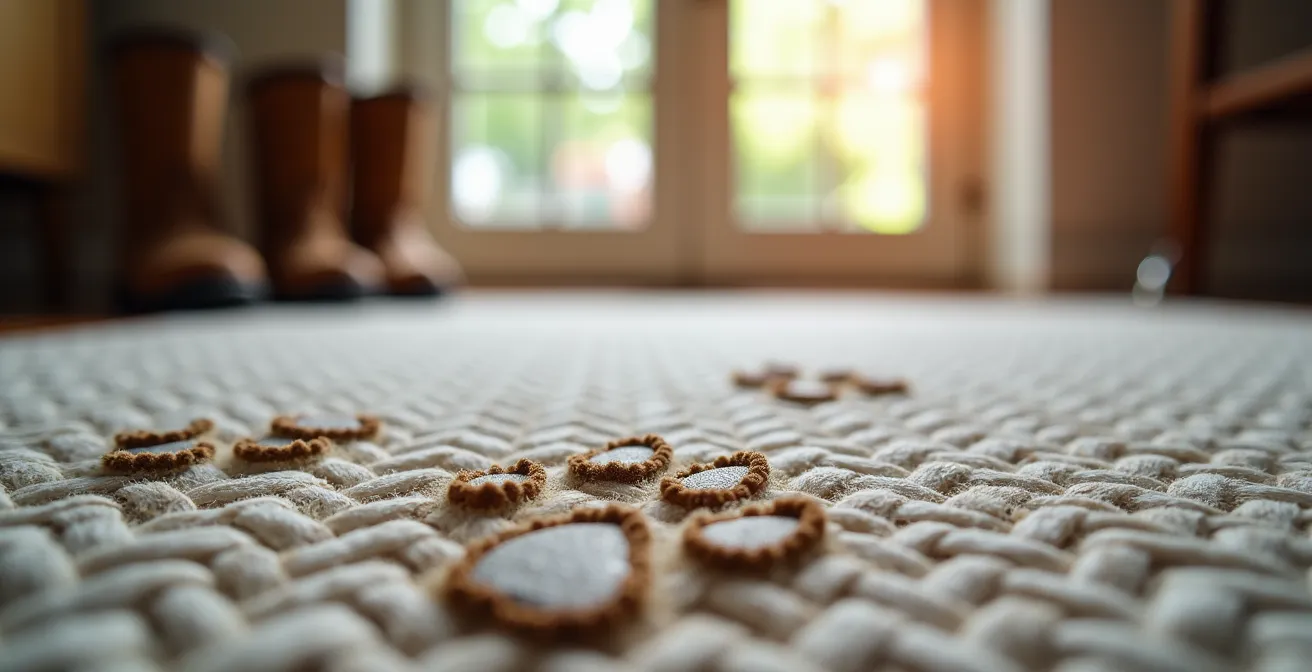
This type of rug transforms a constraint (inevitable dirt) into a simple, manageable inconvenience. The investment is justified by the savings realized on replacing traditional rugs and, above all, by the serenity of knowing that even the worst messes are reversible.
“With our dog constantly coming in and out during the Quebec winter, our Ruggable rug at the entrance has survived slush, road salt, and spring mud. After 2 years and dozens of washes, it’s still impeccable. The initial $350 investment has paid off compared to the 3 traditional rugs we used to throw away every year.”
–Testimony from a Canadian family on Salut Bonjour
Pearl or eggshell finish: which paint truly allows you to wipe away fingerprints without burnishing the wall?
The walls of a family home are a canvas for fingerprints, splashes, and sometimes even unrequested artwork. Choosing a matte paint for its velvety elegance is often a costly mistake because it is porous and difficult to clean without leaving shiny marks (a phenomenon called “burnishing”). The solution lies in choosing the right paint finish. For high-traffic areas like hallways, kitchens, and playrooms, “pearl” finishes (also called “low-lustre satin” or “eggshell” depending on the brand) are ideal.
These finishes contain just enough binder to create a smooth, non-porous surface that is easy to clean with a damp sponge and mild soap, but without the reflective shine of a satin or semi-gloss finish that accentuates wall imperfections. A pearl finish (with 10-25% sheen) offers the best of both worlds: a look matte enough to be chic and excellent washability. Modern “zero VOC” paints, like the Sico Pure or Benjamin Moore Natura ranges, now offer the same durability and washability as traditional paints, making them a safe choice for children’s bedrooms.
Comparative Test: The Cleaning Challenge
A test conducted in Canadian homes put three major brands to the challenge. Benjamin Moore Regal Select in a pearl finish stood out particularly well, withstanding over 500 cleaning cycles without any visible alteration to its color or lustre. It proved its resistance against crayon stains, food, and greasy handprints, confirming that the right paint choice is a form of insurance for your walls.
For optimal protection that will last 5 to 7 years despite frequent cleanings, applying two coats of quality paint over a suitable primer is non-negotiable. It’s an initial investment in time and money that guarantees the longevity of your decor.
Basement playroom or living room play corner: which solution promotes child independence?
The question of where to place the play space is fundamental, and the answer largely depends on your children’s age. It’s not just about containing the mess, but about promoting healthy development. For toddlers (0-4 years), a play corner integrated into the living room is the best solution. At this age, children practice “parallel play”: they play next to you, not necessarily with you, but your presence is reassuring and essential to their safety and emotional development.
Around age 4 or 5, when the child begins to develop independence and imaginative play, transitioning to a dedicated playroom in the basement can be very beneficial. This space belongs to them; they can make more noise there and leave ongoing builds without having to tidy everything up every night, which stimulates creativity and a sense of responsibility. As Dr. Sophie Laroche, a child developmental psychologist at the Université de Montréal, states, “For 0-4 year olds, the living room corner allows for parallel play under constant supervision, which is essential for development. Around age 5, the transition to a dedicated basement space encourages independence and creativity.”
However, converting a basement in Canada into a safe living space for children requires following certain essential rules. Humidity, air quality, and light are absolute priorities.
Action Plan: Setting up a safe basement in Canada
- Radon Testing: Have a radon test performed. According to Health Canada, this is a crucial step, and installing a mitigation system is necessary if levels are high.
- Humidity Control: Install a high-performance dehumidifier to maintain relative humidity between 30% and 50%, thus preventing mold growth.
- Lighting Optimization: Compensate for the lack of natural light with layered lighting, using LED bulbs from 4000K to 5000K for a light close to daylight.
- Thermal Comfort: Ensure a comfortable temperature of 20-22°C with a safe auxiliary heating system, such as electric baseboards with thermostats or radiant flooring.
- Zoning and Safety: Use insulating rugs to define zones (reading, arts, building) and choose low, stable furniture adapted to the children’s size.
What does the “Double Rubs” code mean and how many do you need for a family of 4?
When choosing upholstery fabric, going beyond color and texture is essential. One of the most important but often ignored technical indicators is the “Double Rubs” rating (or Wyzenbeek test). This figure measures the abrasion resistance of a fabric. Specifically, a test simulates the wear caused by a person sitting down and standing up from a piece of furniture. One “double rub” corresponds to one back-and-forth motion. The higher the number, the more durable the fabric.
For purely decorative use, like a cushion or an accent chair in a guest room, a fabric of 9,000 to 15,000 Double Rubs may suffice. However, for the main sofa of a family of four, this is completely insufficient. It is recommended to aim for a minimum of 15,000 to 30,000 Double Rubs for standard residential use. If you have young, active children or a medium-sized dog, it is safer to aim for the “heavy-duty” category, between 30,000 and 50,000 Double Rubs. Commercial-grade fabrics, at over 50,000, offer maximum peace of mind.
This information is a true “insider secret” that allows you to judge the actual quality of a piece of furniture beyond its appearance. According to North American textile industry standards, it is established that a fabric with 30,000 Double Rubs lasts an average of 7-10 years in a family of 4 with daily use. The following table will help you identify your needs.
| Use | Recommended Double Rubs | Examples of situations |
|---|---|---|
| Light residential use | 9,000-15,000 | Guest room, decorative chair |
| Standard family use | 15,000-30,000 | Family sofa without pets |
| Heavy family use with children | 30,000-50,000 | Family of 4, daily use |
| Commercial use/Pets | 50,000+ | 35kg+ dog, several active children |
Key Takeaways
- Family style isn’t about avoiding mess, but about choosing systems (materials, shapes, storage) that anticipate it.
- Durability has an initial cost but it pays off: a washable rug or superior quality paint will save you money in the long run.
- Zoning through light, texture, and sound (sensory zoning) is an effective designer method for separating spaces without walls.
How to zone your home so that the kids’ mess doesn’t contaminate the adult space?
In open floor plans, the biggest fear is that the play space will “contaminate” the entire living area, creating a sense of permanent disorder. The most elegant and effective solution is not to build walls, but to employ psychological or sensory zoning techniques. It’s about creating subtle but clear boundaries that indicate where the play space ends and where the calm, adult-only space begins.
The simplest method is the use of rugs. A rug with a soft, playful texture can define the play corner, while a more sober wool rug anchors the living room area. Furniture can also serve as dividers. A low bookshelf (no more than 1.20 m high to allow for supervision) or a console placed behind the sofa creates a soft physical boundary without closing off the space. Lighting is an extremely powerful zoning tool. By using smart lighting systems (like Philips Hue), you can program “scenes”: a brighter, cooler light (4000K) for the play area during the day, and a warmer, dimmed light (2700K) for the living room area in the evening. These light signals help children intuitively understand the different functions of each zone.
Case Study: Sensory Zoning in Vancouver
A Vancouver family applied these principles in their 95m² condo. They used a washable rug for the play area and a wool rug for the living room. Distinct lighting scenes were programmed, and an essential oil diffuser with an energizing scent (citrus) was used in the play corner, versus a relaxing scent (lavender) on the living room side. A storage bench was placed as a transition “gate” between the two zones. Within three weeks, the children naturally began to respect these invisible boundaries, and tidying up into the storage bench became a reflex.
By adopting these strategies, you’re not just protecting your home; you’re designing an environment that actively supports each family member’s needs while reflecting your sense of style. To put these tips into practice, the next step is to evaluate your own spaces and identify one or two priority strategies to implement.
Frequently asked questions about stylish family design
What is the difference between a pearl and satin finish for families?
The pearl finish offers a subtle lustre (10-25% sheen) ideal for high-contact walls, while satin (25-35% sheen) is glossier but even more washable, perfect for high-traffic transition areas.
Are ‘zero VOC’ paints truly effective for cleaning?
Yes, modern ranges like Benjamin Moore Natura or Sico Pure offer the same washability as traditional paints while being safe for children.
How many coats are necessary for optimal protection?
Two coats of quality paint over a good primer guarantee a durability of 5-7 years, even with frequent cleaning.