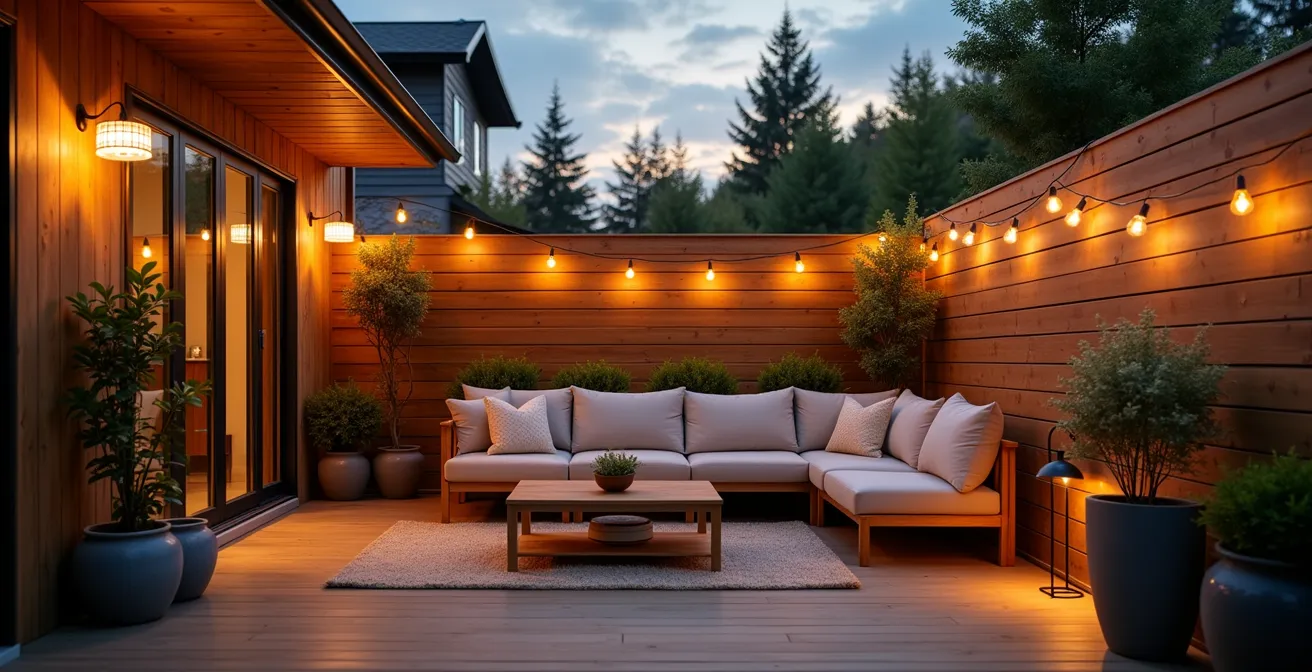
The key to mosquito-free summer evenings in Canada lies not in a miracle repellent, but in a comprehensive landscaping strategy that makes your deck hostile to insects.
- Passive solutions like citronella are largely insufficient; an active, multi-layered defense is required.
- Every decision, from lighting to the choice of patio heater, has a direct impact on mosquito attraction.
Recommendation: Analyze your outdoor space as an ecosystem and modify its elements (airflow, heat, light) to actively discourage the presence of mosquitoes.
The scene is familiar to every Canadian homeowner: a mild June evening, the barbecue crackling, friends laughing… until the dreaded buzzing begins. Quickly, the evening turns into a nightmare, and everyone retreats indoors, frustrated at being unable to enjoy the outdoor space they worked so hard for. Faced with this seasonal invasion, the reflexes are often the same: we light citronella candles, spray ourselves with bug repellent, and promise to buy one of those famous electric “zappers.” Yet, year after year, the result is disappointing.
These traditional solutions address the symptoms but rarely the root cause of the problem. They aim to repel the enemy once they are already on the battlefield. But what if the real key wasn’t to repel mosquitoes, but rather to never attract them in the first place? The most sustainable and effective solution consists of transforming your backyard into an ecosystem of comfort for you, but one that is actively inhospitable to biting insects. It is an approach of “atmosphere engineering,” where every landscaping choice, from the fencing to the type of light bulb, becomes a piece of your multi-layered defense strategy.
This article will guide you through this pragmatic approach. We will deconstruct myths, analyze the impact of your landscaping choices on insects, and provide concrete solutions so you can finally reclaim your summer evenings, from sunset until the crisp air of October.
To help you navigate this comprehensive strategy, here are the key points we will cover. Each section is a piece of the puzzle to build your mosquito-free oasis.
Summary: Enjoying your backyard in the evening without being eaten alive by mosquitoes?
- Why planting citronella is often insufficient to repel mosquitoes in Canada?
- Cedars or wood panels: which solution best blocks the view of immediate neighbors?
- Propane patio heater or electric infrared: which is more economical for October evenings?
- The mistake of installing security floodlights that kill the cozy atmosphere of your evenings
- How to use the sound of water to mask neighbor conversations or traffic?
- When to book your landscaper to ensure your yard is ready by June?
- The trap of designing a glass-enclosed area without providing adequate ventilation for July
- Sectional or individual armchairs: which configuration best promotes conversation on your terrace?
Why planting citronella is often insufficient to repel mosquitoes in Canada?
The myth of the citronella miracle plant is persistent. Every spring, Canadian garden centers see an influx of customers convinced that a planter of Pelargonium citrosum will be enough to create a protective bubble. The reality, unfortunately, is much more disappointing. The effectiveness of these plants relies on the oil they contain, which is only released in significant quantities when the foliage is crushed. A plant growing quietly on your patio has almost zero effect. It is a first layer of psychological defense rather than an effective chemical barrier. Science confirms this low efficacy: citronella oil-based repellents offer 30 minutes to 2 hours of protection maximum, far from the six hours provided by products containing DEET.
Worse still, the plant sold as a “mosquito plant” can even be counterproductive. Experiments conducted at the University of Guelph in Canada on Pelargonium citrosum demonstrated its total ineffectiveness. Not only did the plant not keep mosquitoes away, but researchers regularly observed insects resting directly on its foliage. Citronella should therefore not be the pillar of your strategy, but at most a pleasant olfactory complement. The real battle is fought on other grounds, by creating a global environment that is unfavorable to mosquitoes.
The solution is not a single plant, but a multi-layered defense. Think about disrupting their flight with a fan, intercepting them from a distance with a CO2 trap, and above all, designing your layout to minimize the elements that attract them. Citronella is the front line of an army that requires several others, much more robust, to win the battle.
Cedars or wood panels: which solution best blocks the view of immediate neighbors?
The need for privacy is often the starting point for backyard landscaping. The choice between a cedar hedge and wood privacy panels seems purely aesthetic, but it has direct consequences on your comfort and… on the mosquito population. Cedars, while natural and excellent for sound absorption, can become an unintended ally for insects. A very dense hedge blocks air circulation, creating calm, humid zones where mosquitoes, which are poor flyers, like to take refuge during the day.
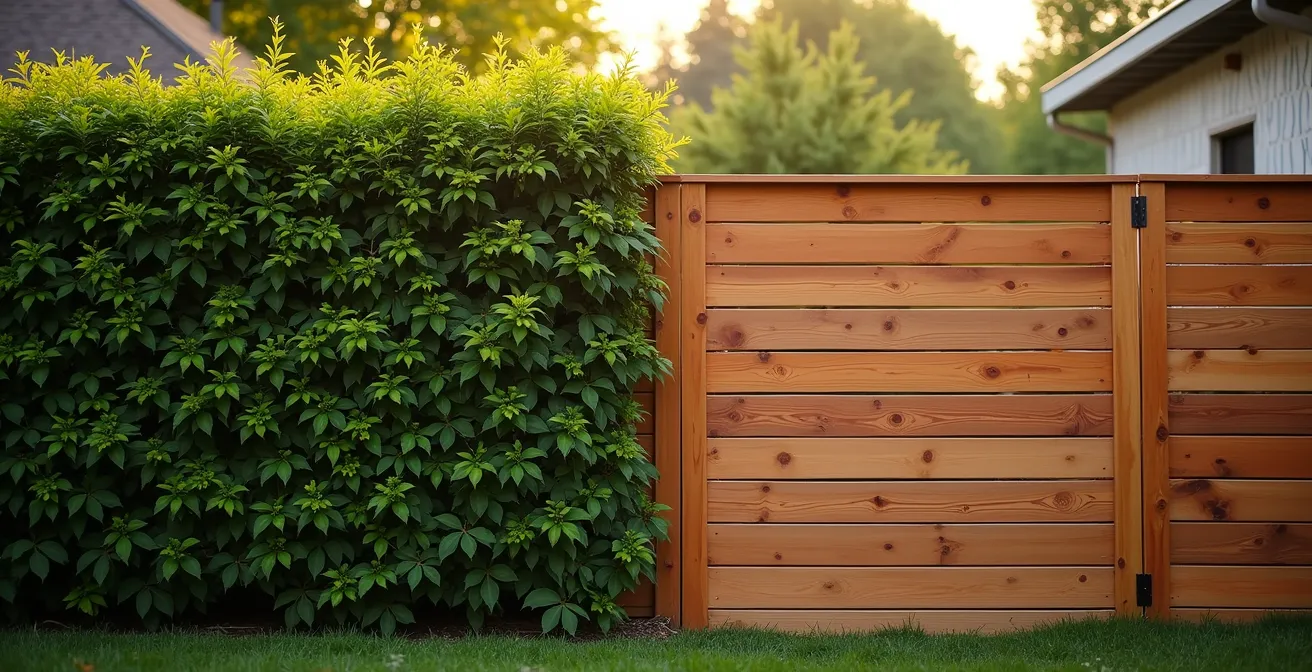
Modern wood panels, especially those with horizontal slats and slight spacing, offer a more strategic solution. They effectively block direct views while allowing the breeze to circulate, drying out the area and making it less attractive to mosquitoes. Although they may reflect sound, their main advantage lies in this control of the immediate environment of the terrace. The choice will therefore depend on a trade-off between the natural acoustic absorption of cedars and the better ventilation offered by panels.
The following table summarizes the compromises to be made between these two popular solutions in Canada, keeping in mind the goal of a comfort ecosystem.
| Criterion | Cedar Hedge | Wood Panels |
|---|---|---|
| Air circulation | Can block air and create a humid zone conducive to mosquitoes | Allows for better circulation depending on spacing |
| Acoustic absorption | Diffuses sound naturally | Reflects sound (can create an echo) |
| Max legal height (varies by municipality) | Often 3m for hedges | Generally 2m for fences |
| Annual maintenance | Regular pruning required | Wood treatment every 2-3 years |
It is also crucial to check your local municipal regulations, as maximum authorized heights often differ between a “hedge” and a “fence.”
Propane patio heater or electric infrared: which is more economical for October evenings?
Extending the patio season into the cool evenings of October is a common goal. The choice of patio heater, however, has implications that go beyond the wallet. The propane “mushroom” style heater is a classic. It heats the surrounding air, creating a diffuse bubble of warmth. Its major flaw in our fight against mosquitoes is that it is a powerful attractant. Indeed, its combustion releases carbon dioxide (CO2) and water vapor, two of the main signals female mosquitoes use to locate their warm-blooded prey. Ironically, by seeking comfort, you are sending an open invitation to insects.
The electric infrared patio heater, on the other hand, works on a different principle. It does not heat the air, but directly heats objects and bodies through radiation, much like the sun. It is therefore more effective in windy weather and, above all, emits no attractants for mosquitoes. From an economic standpoint, although the initial cost may be higher, the operating cost is often lower, especially with competitive hydroelectric rates in several Canadian provinces. You get targeted heat without waste and without attracting unwanted guests.
The following comparative analysis clearly illustrates why electric infrared is often the strategic choice for uncompromised comfort.
| Criterion | Propane | Electric Infrared |
|---|---|---|
| Avg cost for 3h (Canada estimate) | $5-8 (20 lb tank) | $2-4 (depending on provincial kWh rate) |
| Efficiency in wind | Heat dissipates quickly | Directly heats bodies/objects |
| Mosquito attraction | Emits CO2 and humidity (attractants) | No attractive emissions |
| Heating zone | 3-5m radius (ambient heat) | Targeted 2-3m (direct radiation) |
The mistake of installing security floodlights that kill the cozy atmosphere of your evenings
Lighting is one of the most underestimated aspects of creating a comfortable, mosquito-free terrace. The classic mistake is to install powerful security floodlights that flood the yard with cold white light. In addition to destroying any intimate atmosphere, this light is a veritable beacon for flying insects. Studies show that insects are strongly attracted to short-wavelength light, such as blue and ultraviolet (UV), which are abundant in “cool white” LED bulbs.
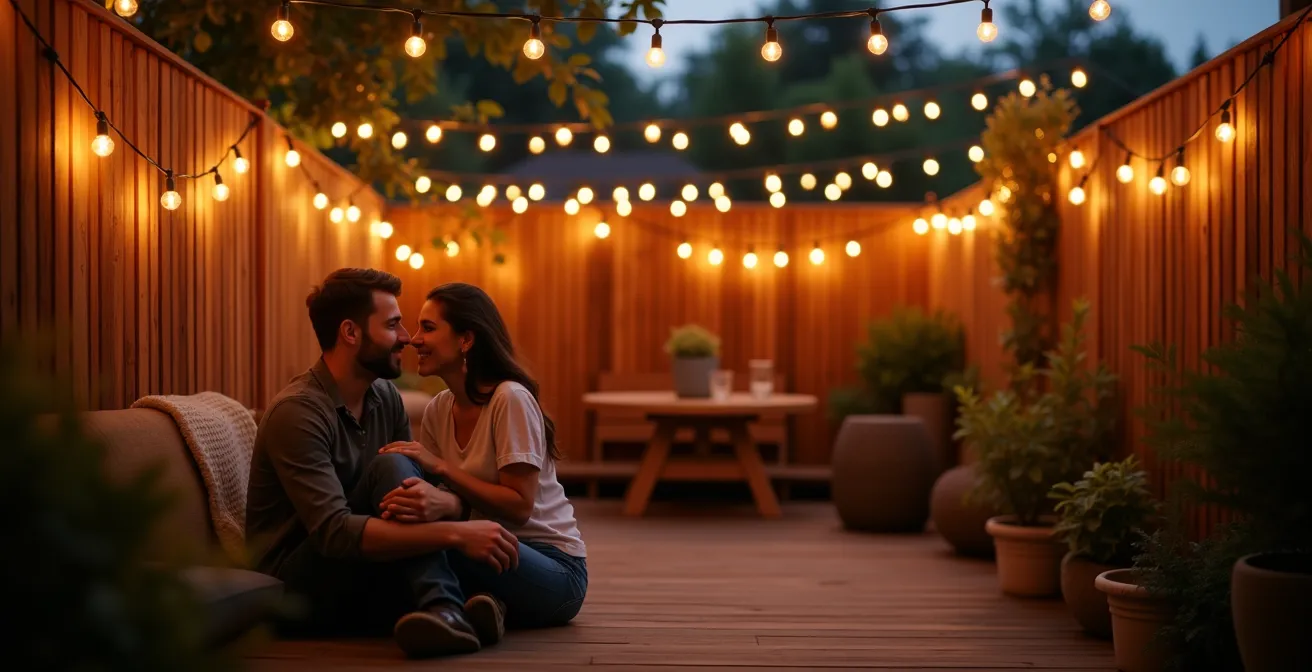
The solution lies in a strategy of indirect and warm lighting. Opt for LED bulbs of maximum 2700 Kelvins (K), which produce “warm white” or even amber light. These longer-wavelength lights are much less visible to most insects. Rather than lighting your table or chairs directly, aim the light sources at vertical surfaces like a house wall or a fence. This indirect lighting creates a soft ambient brightness, sufficient to see clearly, but without glaring or attracting swarms of insects. Placing light fixtures away from main seating areas is also a winning tactic.
This approach transforms lighting from a simple functionality into a powerful tool for sculpting the atmosphere and managing nocturnal wildlife. This is the very essence of atmosphere engineering.
Your action plan for mosquito-repellent lighting:
- Choose the right bulbs: Only buy LED bulbs of maximum 2700K (very warm white) or amber, easily available in Canadian hardware stores.
- Prioritize indirect lighting: Install your lights so they illuminate vertical surfaces (walls, fences) rather than your living area.
- Avoid direct lighting: Never place a powerful spotlight directly above your table or chairs.
- Distance the light sources: Position the necessary fixtures at a certain distance from where you sit.
- Think of the wildlife: Consider “Dark Sky Friendly” certified fixtures to minimize light pollution and protect local nocturnal wildlife.
How to use the sound of water to mask neighbor conversations or traffic?
Privacy is not just visual; it is also auditory. Constant traffic noise or neighbor conversations can be just as disturbing as their gaze. An elegant and natural solution to create a sound bubble is to integrate a fountain or a small water wall. The sound of moving water, particularly the mid-to-high frequencies of a splash, is very effective at masking unwanted noises like human voices or the hum of cars. This is known as acoustic “white noise.” A small closed-circuit fountain, strategically placed near the seating area, can radically transform the soundscape of your terrace.
However, there is a major trap: standing water. Adding a water feature must never come at the expense of mosquito control. Mosquitoes lay their eggs in the smallest puddle of stagnant water. It is therefore imperative to choose a fountain where the water is in constant motion and to ensure that no catchment basin creates a stagnant zone. Expert warnings are unequivocal, as Julia Mlynarek, an entomologist at the Montreal Insectarium, points out: everything must be done to eliminate it. Specialist opinion is unanimous, as according to the Montreal Insectarium, 100% of experts recommend eliminating all stagnant water, as it is the primary breeding site.
The entomologist from the Montreal Insectarium, Julia Mlynarek, insists on this crucial point:
We can try to remove any source of standing water to prevent mosquitoes from laying eggs there – empty planters, buckets, tarps, rain barrels, wheelbarrows, unused outdoor pools, old tires, kayaks.
– Julia Mlynarek, Entomologist at the Montreal Insectarium
The sound of water is a powerful tool for acoustic privacy, provided it is designed with the mosquito threat in mind. Regular maintenance and proper design are non-negotiable.
When to book your landscaper to ensure your yard is ready by June?
Creating a successful terrace ecosystem cannot be improvised. If you are planning major landscaping work, hiring a landscaper is often the best approach. However, in Canada, the best professionals are booked months, if not a year, in advance. Waiting until spring to contact them is a near-certain guarantee of not having a yard ready for mosquito season. The secret is to adopt an anti-cyclical booking strategy. You need to think about your summer yard in the heart of autumn or winter.
The ideal timeline varies slightly by Canadian region due to different climates and work cycles. Here is a general guide to avoid being caught off guard:
- West Coast (British Columbia): The milder climate allows for work almost year-round. Contact landscapers in September-October to plan a project for the following spring.
- Prairies (Alberta, Saskatchewan, Manitoba) and Ontario: The working season is shorter and more intense. Order books fill up fast. It is wise to reserve your spot between October and November.
- Quebec and Maritimes: This is where anticipation is most critical. Renowned landscapers are often fully booked by January. It is imperative to make contact before the holiday season.
Contacting a professional in the middle of summer for the following year also has an advantage: it allows them to see your land at its full potential, observe sunlight, prevailing winds, and problem areas. During the meeting, ask targeted questions: “How do you integrate drainage to avoid stagnant water?” or “Which local plants encourage natural mosquito predators (swallows, bats)?”. A good landscaper doesn’t just think about aesthetics; they think about the ecosystem.
The trap of designing a glass-enclosed area without providing adequate ventilation for July
A solarium, a three-season veranda, or a glass gazebo seems like the perfect solution for enjoying the outdoors while being protected from insects. This is true, but on one crucial condition: adequate ventilation. Without it, your dream shelter will turn into a sweltering greenhouse during the hot days of July. A poorly designed solarium can easily see temperatures climb to over 40°C on a sunny 25°C day, making it completely unusable. The resulting stagnant, humid air is not only uncomfortable but can also become a haven for any mosquitoes that manage to slip inside.
The key is to design the ventilation from the start. It’s not just about having windows that open, but about creating a real draft. An effective strategy relies on several pillars:
- Cross-ventilation: Placing windows or openings on opposite walls to allow air to pass through the space.
- Convection ventilation (stack effect): Providing low openings to let fresh air in and high openings (transom windows, opening skylights) to let hot air escape.
- Adding fans: One or more ceiling fans designed for outdoor use are an excellent addition. The airflow they generate (a minimum of 2-3 km/h) is very effective at preventing mosquitoes—which are poor flyers—from flying and settling.
This constant air circulation serves a dual purpose: it cools the space for your comfort and creates a hostile environment for insects. A glass space without ventilation is an incomplete physical barrier; a well-ventilated space is an active barrier.
Key Takeaways
- Multi-layered defense is the only viable strategy: Forget the miracle solution. Your success will rely on combining several tactics (airflow, light type, heat source, physical barriers).
- Every landscaping choice is a anti-mosquito decision: From the fence to the light bulb, every element of your terrace has an impact on attracting or repelling insects.
- Anticipation is crucial: Whether it’s for the ventilation of a solarium or booking a landscaper, planning well in advance is the key to having a yard ready in time for the Canadian summer.
Sectional or individual armchairs: which configuration best promotes conversation on your terrace?
The choice of furniture structures the use of your terrace. Beyond style, the configuration has a direct impact on social dynamics and, surprisingly, on comfort regarding the elements and insects. A sectional, often in an ‘L’ shape, is excellent for relaxing, but it can be less conducive to group conversation. Its linear shape tends to create “end seats” that isolate some guests, and the group faces only one direction. Individual armchairs, on the other hand, offer unparalleled flexibility. They allow for the formation of a circle where eye contact happens naturally, promoting a more inclusive conversation.
Case Study: Proxemics applied to terrace design
The study of social distance (proxemics) shows that the arrangement of individual armchairs allows everyone to adjust to maintain a comfortable distance, turn toward the main speaker, or form sub-discussion groups. More importantly for long Canadian evenings, this flexibility allows everyone to reposition themselves to avoid a cold draft, move closer to an infrared heater, or move away from an area more exposed to mosquitoes. A sectional, being a monolithic piece, imposes a fixed configuration on the group, while armchairs allow for dynamic and individual adaptation to the environment.
This flexibility is a major asset in our multi-layered defense strategy. If one area of the terrace is less protected by the fan or too close to a light source, guests can simply move their chair. With a sectional, the group is more compact, but also more static and potentially more exposed. The choice between these two options is therefore not just a matter of the number of seats, but a strategic decision on the adaptability of your space to the changing conditions of a summer evening.
By integrating these principles into your backyard design, you are not just repelling mosquitoes; you are creating an outdoor space that is truly comfortable, functional, and welcoming for you and your guests. Start analyzing your terrace now, not as a problem to be solved, but as an ecosystem to be optimized.