The real performance of a window in Quebec isn’t found on a simple label, but in the technical details that guarantee its survival against climatic extremes.
- The type of inert gas and the quality of the frame are more decisive for insulation and durability than the mere number of glass panes.
- Amateur installation can negate up to 30% of a high-end window’s efficiency, making installer qualification non-negotiable.
Recommendation: Demand to understand the thermal expansion coefficient of the frame materials and the method for connecting it to your home’s air barrier before signing any contract.
The frost that accumulates in the bottom corner of your windows every winter isn’t just a nuisance; it’s a symptom of a financial hemorrhage. Faced with this, the common reflex is to turn to “ENERGY STAR” labeled windows, thinking this label is an absolute guarantee of performance. However, this approach is often incomplete and can lead to disappointing investments, especially in Canada’s harsh climate.
Standard advice focuses on the number of panes or the frame material but skims over the true points of failure. The real question isn’t whether a window is “good” in the absolute sense, but whether it is specifically designed to endure freeze/thaw cycles shifting from -30°C to +30°C without its seals failing or its frame warping. The key is not in the label, but in understanding the physical principles governing heat loss and structural durability.
This article proposes to go beyond marketing arguments to help you become an informed buyer. We will break down, point by point, the technical aspects that make the difference between a window that suffers through the Quebec winter and one that masters it. From the composition of the gas between the panes to the physics of frame materials, including the critical installation stage, you will learn to ask the right questions and identify products that represent a lasting investment rather than a recurring expense.
To guide you through this technical analysis, this article is structured to address each critical component of window performance. The table of contents below will allow you to navigate through the key elements to master for an informed and profitable choice.
Summary: Understanding Real Window Performance in Canada
- Why is the gas between the panes as crucial as the glass itself in winter?
- Triple glazing: Is it truly cost-effective in Southern Quebec or an unnecessary luxury?
- PVC or Aluminum Hybrid: Which frame best resists yellowing and warping?
- The error of hiring an amateur installer who cancels out all your new window’s performance
- When to change your windows: 3 failure signs that caulking can no longer fix
- Why is your home losing so much heat even with new windows?
- Security bars or film: How to protect vulnerable ground-level access points?
- How to reach a higher energy rating without tearing down all your walls?
Why is the gas between the panes as crucial as the glass itself in winter?
The space between the two or three panes of your window is not filled with air, but with an inert gas, most often argon or, more rarely, krypton. This gas plays a fundamental role as a thermal barrier. Being denser than air, it considerably slows down heat transfer by convection between the inner and outer glass panes. In winter, it prevents cold from penetrating; in summer, it blocks heat. It is this gas that allows the inner surface of your glass to stay at a temperature close to that of the room, thus avoiding the “cold wall” sensation and the appearance of condensation, the famous dew point.
The performance of this gas depends entirely on the airtightness of the sealed unit. Over time and through freeze/thaw cycles that cause materials to expand and contract, the seal can degrade. According to the Association des consommateurs pour la qualité dans la construction (ACQC), a sealed unit in Canada has a lifespan of 15 to 25 years. After this period, the gas gradually escapes and is replaced by moist air, nullifying much of the insulating performance. Persistent fogging between the panes is the infallible sign of this failure.
The choice of gas is also strategic. Argon is the standard, offering an excellent performance/price ratio with an optimal spacing of 16 mm between panes. Krypton is more efficient and allows the spacing to be reduced to 12 mm, which can be useful for thinner renovation frames. However, its cost is much higher due to its rarity and the energy required for its extraction, reserving it for specific projects where every millimeter counts.
To determine if your sealed unit is failing, a few observations are necessary:
- Condensation location: If it is on the outside, it’s a sign that your window is performing very well. If it is on the inside, it is often a problem of high ambient humidity. If it is between the two panes, the seal is broken.
- Visual examination: Look for signs of corrosion or discoloration on the metal or composite spacer located between the panes.
- Flame test: On a windy day, hold a candle flame near the frame. If it flickers strongly, it indicates air infiltration at the frame joints, a distinct but often concomitant problem.
Triple glazing: Is it truly cost-effective in Southern Quebec or an unnecessary luxury?
The question of double vs. triple glazing is at the heart of energy performance debates. On paper, triple glazing is a champion. According to Natural Resources Canada, triple-glazed products can be up to 50% more efficient than double-glazed models at retaining heat. This performance is primarily measured by the U-factor, which indicates the amount of heat lost. The lower it is, the better the insulation. A good double-glazed window will have a U-factor around 1.1 to 1.4, while a high-performance triple-glazed window will drop to between 0.5 and 0.8.
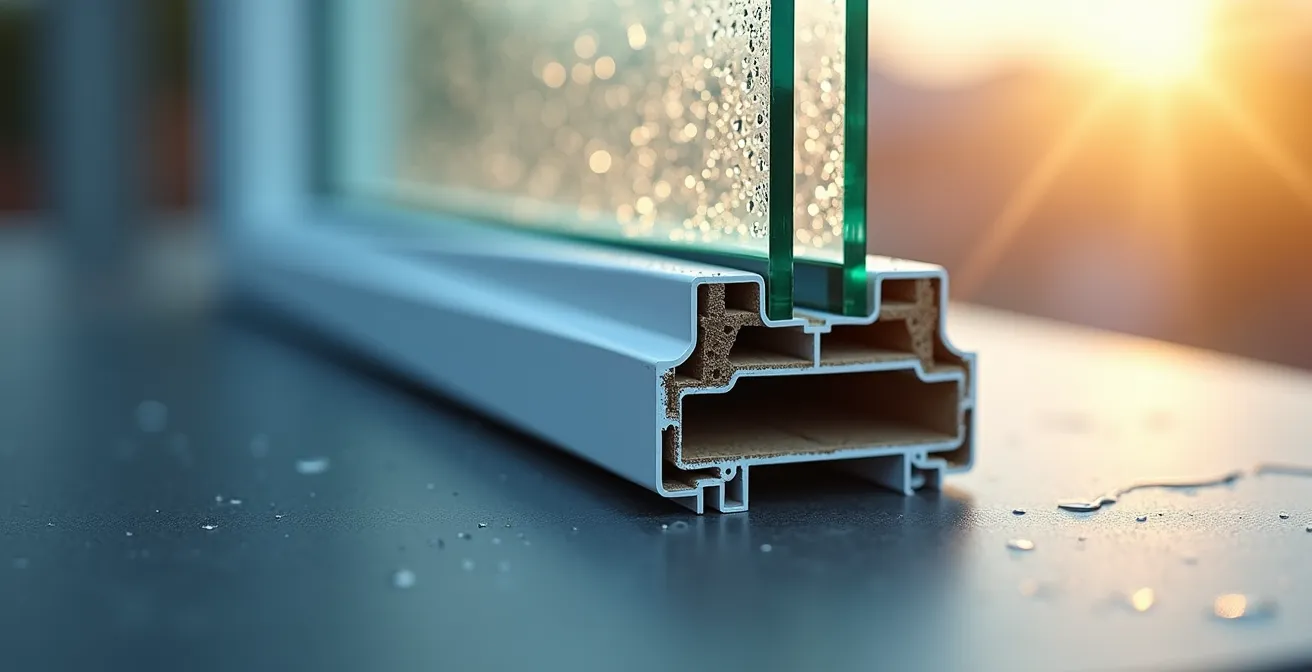
However, this performance comes at a cost and introduces trade-offs, particularly regarding passive solar gain (SHGC). This coefficient measures the window’s ability to let in solar heat. During a Quebec winter, this free heat gain is precious. By adding a third pane, you not only reduce losses but also these solar gains. In Canada’s coldest climatic zones (Zone 3), insulation takes priority and triple glazing is often indispensable. But in Southern Quebec (Zones 1 and 2), where winters are harsh but sunshine remains significant, the calculation is more nuanced.
The following table, based on data compiled for the Quebec context, highlights the trade-offs to consider.
| Criterion | Double Glazing (High Performance) | Triple Glazing |
|---|---|---|
| U-Factor (W/m²K) | 1.1 – 1.4 | 0.5 – 0.8 |
| Solar Heat Gain (SHGC) | ~0.65 | ~0.50 |
| Light Transmission | ~80% | ~70% |
| Initial Extra Cost | Reference | +60-80% |
| Return on Investment (ROI) | 5-8 years | 10-15 years |
| Comfort Near Windows | Good | Excellent |
| Recommended Climate Zones (Canada) | Zone 1-2 | Zone 2-3 |
The choice is therefore not purely technical, but strategic. For a well-oriented south-facing house, an excellent double-glazed window with a high SHGC can prove more cost-effective in the long run than a triple-glazed window which, while more insulating, blocks part of the free solar heat. Triple glazing is fully justified on north-facing facades, which receive less sun, or for homeowners seeking maximum acoustic and thermal comfort, even at a higher cost and longer ROI.
PVC or Aluminum Hybrid: Which frame best resists yellowing and warping?
If the glazing is the heart of thermal performance, the frame is the skeleton. A frame that warps or degrades under thermal shock jeopardizes the airtightness of the entire window. In Canada, the choice of materials is critical. PVC (polyvinyl chloride) dominates the market due to its accessible cost and good insulating properties. However, not all PVC is created equal. Entry-level PVC, low in UV stabilizers and titanium dioxide, risks yellowing and becoming brittle under the combined effect of intense summer sun and extreme winter cold.
For the Canadian climate, it is imperative to opt for Grade A PVC, specifically formulated to resist these conditions. This type of PVC guarantees color stability and structural flexibility over the long term. However, PVC has a physical limit: its thermal expansion coefficient is relatively high and very different from that of glass. During large temperature fluctuations, the frame and glazing do not expand and contract at the same rate, exerting constant stress on the seals.
This is where composite and hybrid materials come in. Hybrid windows combine a structural aluminum frame on the exterior for rigidity and durability with a PVC interior for insulation. This solution offers excellent structural resistance. Another cutting-edge option is fiberglass. Its main advantage is its thermal expansion coefficient, which is almost identical to that of glass. The frame and glazing “move” together, which considerably reduces stress on the seals and ensures much more durable airtightness. Although more expensive, fiberglass often represents the best long-term investment in an extreme climate like Quebec’s. The performance of all these products is governed by the Canadian standard CSA A440, which defines minimum requirements for air, water, and wind load resistance.
The error of hiring an amateur installer who cancels out all your new window’s performance
You can invest in the highest-performing window on the market, equipped with krypton-filled triple glazing and a fiberglass frame, but if the installation is botched, your investment will be in vain. Studies estimate that a poorly installed window with poorly sealed gaps around the frame can negate up to 30% of its thermal performance. Installation is not a mere formality; it is the step that integrates the window into your building’s envelope.
The most critical point in Canada is ensuring the continuity of the airtightness plane. Every house has an air barrier and a vapor barrier in its walls. When replacing a window, the installer must meticulously connect the new unit to these existing membranes. If there is a break in this continuity, cold air will infiltrate in winter and, worse, warm moist air from inside the house will migrate into the wall cavity. Upon hitting the cold point, this moisture will condense, creating an environment ripe for mold and rot in the wall structure.
A qualified installer will use a precise sequence of flashings, self-adhesive sealing membranes, and low-expansion insulating foams to create a perfect seal. They must also manage the drainage plane to ensure that any water that might infiltrate is directed outward and not into the wall. The installation must comply with the CAN/CSA-A440.4-07 standard, which specifically governs window installation methods in Canada.
Action Plan: Auditing Your Potential Installer
- Certification Check: Is the installer certified by a recognized program (e.g., Fenestration Canada) and do they hold a valid RBQ license?
- Technical Questioning: Ask them how they plan to ensure continuity between the house’s air/vapor barrier and the new window frame.
- Materials Inventory: What types of flashings, membranes, and insulating foams will be used? Are they specifically designed for the Canadian climate and low temperatures?
- Warranty Verification: Demand up-to-date liability insurance and a written warranty specifically covering installation labor, in addition to the manufacturer’s warranty.
- Integration Plan: Ask if the installation will respect the CSA-A440.4 standard and how the drainage plan around the window will be managed to evacuate water.
When to change your windows: 3 failure signs that caulking can no longer fix
Before launching into an expensive replacement project, it is essential to diagnose whether your windows are truly at the end of their life or if simple maintenance, such as replacing exterior caulking, might suffice. Cracked caulking can be redone, but certain signs indicate structural failure that sealant cannot fix. Here are the three main red flags.
The first and most obvious is the presence of condensation or frost between the panes. As we’ve seen, this is the irrefutable sign that the sealed unit has lost its inert gas. The window’s insulating performance is then permanently compromised. No amount of caulking can repair a broken seal. The only solution is to replace the sealed unit or the entire window.
The second sign is the physical degradation of the frame. For wood windows, look for signs of rot, especially in the bottom corners where water tends to collect. For older generation PVC windows, visible warping, cracks, or softening of the material indicate it has lost its structural integrity. A window that suddenly becomes difficult to open or close can also be a symptom of frame warping. These structural problems affect overall airtightness and cannot be resolved with a simple bead of sealant.

Finally, the third sign is confirmed water infiltration. Do not confuse a small air leak (which can often be corrected) with water infiltration. Moisture stains, bubbling paint on the interior trim, or worse, traces of mold around the window are indicators that water is penetrating the structure. This means the sealing barriers (flashing, membranes) integrated into the wall have failed—a much more serious problem than a simple defective caulking joint. At this stage, window replacement is necessary to inspect and repair the building envelope.
Why is your home losing so much heat even with new windows?
Replacing all your windows only to find that heating bills barely drop is a source of immense frustration. The cause is often a misunderstanding of building science: a house is a system, and windows are just one component. Treating windows in isolation without considering the rest of the envelope is often a costly mistake. As the public organization France Rénov’ notes in its guide on window replacement:
Replacing your windows is an intermediate solution, as heat primarily escapes through the roof and walls. By coupling the replacement of your windows with wall insulation, you will best address thermal bridges.
– France Rénov’, Guide to Window and Door Replacement
A phenomenon particularly pronounced in multi-story Canadian homes is the stack effect (or thermal draft). In winter, warm air, being lighter, naturally rises in the house. If it finds leakage points on the upper floors (poorly sealed windows, unsealed attic hatch), it escapes. This upward air leak creates negative pressure at the bottom of the house, which literally sucks in cold exterior air through every available crack in the basement or ground floor (bottom of walls, rim joists, etc.).
Case Study: The Impact of the Stack Effect in Canada
According to analyses conducted on Canadian residential buildings, the stack effect can be responsible for a 15% to 20% increase in heat loss. This means that even if you install perfectly airtight new windows on the ground floor, the suction created by leaks upstairs can continue to pull cold air through other weak points, nullifying some of the expected gains. The solution is therefore not just to have high-performance windows, but to ensure the airtightness of the entire building, from the basement to the roof.
Before replacing your windows, it is wise to have a blower door test performed by an EnerGuide advisor. This test pressurizes your home to precisely locate all air leaks. It helps establish a global renovation strategy and prioritize the most cost-effective work, which often combines window replacement with roof insulation and foundation sealing.
Security bars or film: How to protect vulnerable ground-level access points?
Ground floor and basement windows are potential entry points that require special attention regarding security. Several solutions exist, with significant trade-offs in terms of cost, aesthetics, and compliance with the National Building Code of Canada, which requires that bedroom windows remain viable emergency exits (egress).
The most deterrent solution is the installation of metal bars. However, fixed bars are to be avoided for bedrooms as they block escape in case of fire. Models with a quick-release mechanism exist and are compliant, but they are more expensive and their mechanism must be maintained to remain functional. An increasingly popular alternative is security film. Applied to the interior face of the glass, this thick, transparent film holds the glass in place even after it has been broken. It does not prevent the initial break, but it considerably delays intrusion, which is often enough to discourage a burglar. Its great advantage is being invisible and never obstructing an emergency exit.
Another integrated option is to opt for security glass directly in the new window. This can be tempered glass (more impact-resistant) or laminated glass (similar to a car windshield, with a plastic interlayer that holds fragments). Laminated glass offers the best anti-intrusion protection. The following table compares these different approaches.
| Solution | Average Cost per Window | Advantages | Disadvantages | Building Code Compliance (Bedroom) |
|---|---|---|---|---|
| Fixed Bars | $200-$500 | Maximum deterrence, very robust | Blocks emergency exit, “prison” look | Non-compliant |
| Quick-Release Bars | $400-$800 | Security + evacuation possible | More expensive, mechanism needs maintenance | Compliant if approved |
| Security Film | $50-$150 | Invisible, UV protection, retains shards | Does not prevent initial glass breakage | Always compliant |
| Laminated/Tempered Glass | $300-$600 (surcharge) | Integrated into glazing, very resistant | Requires full glazing replacement | Compliant |
The best approach is often a layered strategy, combining several measures for optimal protection. A good strategy might include the following elements:
- Visual Deterrence: Exterior lighting with motion sensors.
- Signage: Stickers indicating an alarm system (even if fake).
- Physical Reinforcement: Security film or compliant bars on the most vulnerable windows.
- Locking: High-quality locks and, if possible, security bars for sliding windows.
- Detection: Opening or glass-break sensors connected to an alarm system.
Key Takeaways
- Window performance in Canada depends more on the quality of components (gas, spacers, frame) and installation than on the simple number of panes.
- The airtightness of the entire house (stack effect) is a critical factor; replacing windows alone does not guarantee maximum savings.
- A fenestration strategy adapted to facade orientation (insulation on the north, solar gain on the south) is smarter than a uniform choice for the whole house.
How to reach a higher energy rating without tearing down all your walls?
Achieving high energy performance doesn’t necessarily mean embarking on destructive renovations. A smart fenestration strategy is one of the most effective interventions. By choosing adapted products and planning wisely, you can considerably improve your home’s energy balance. Opting for ENERGY STAR certified windows for your climate zone is an excellent starting point. According to the Government of Canada, ENERGY STAR certified windows save an average of 8%on monthly heating bills compared to standard models.
To go further, a fenestration strategy by orientation is remarkably effective. Instead of installing the same type of window everywhere, the glazing is adapted to each facade:
- North Facade: Absolute priority to insulation. Choose the lowest possible U-factor (e.g., triple glazing), as solar gains are almost zero here in winter.
- East and West Facades: Aim for a balance with a low U-factor and a moderate SHGC to avoid overheating from the low morning and evening summer sun.
- South Facade: This is the strategic facade. Aim for a good U-factor, but especially a higher SHGC (around 0.3 to 0.4) to maximize free passive solar gain during winter. As Écohabitation recommends for unshaded south walls in Canada, this balance is key.
Finally, it is crucial to take advantage of financial assistance programs. The Canada Greener Homes Grant offers significant rebates for replacing windows with ENERGY STAR approved models. The process, while rigorous, is worthwhile. It mandatory involves an EnerGuide evaluation before and after the work, conducted by a licensed advisor. This evaluation provides a detailed report that not only makes you eligible for the grant but also gives you a clear roadmap of the most cost-effective improvements for your specific property.
By mastering these technical concepts, you move from being a passive consumer to an enlightened manager of your project. Your choice of future windows will no longer be based on brochures, but on a technical analysis tailored to the reality of your home and the Quebec climate. To put these tips into practice, the next step is to obtain detailed quotes that specify not only the products but also the installation method and the standards respected.
Frequently Asked Questions about Choosing Windows in Canada
What is the CSA A440 standard mentioned for windows in Canada?
The CSA A440 standard governs window performance in Canada, establishing criteria for thermal resistance (U-factor), air and water tightness, and structural resistance adapted to the Canadian climate. It is an essential guarantee of quality and compliance.
Why is Grade A PVC important in Canada?
Grade A PVC contains UV stabilizers and titanium dioxide specifically dosed to resist the freeze/thaw cycle and intense Canadian summer sun, unlike entry-level products that may yellow, warp, or become brittle over time.
What is special about fiberglass for the Canadian climate?
Its thermal expansion coefficient is almost identical to that of glass. During variations from -30°C to +30°C, the frame and glass expand and contract similarly, which considerably reduces stress on the seals and ensures better durability.