
Buying a durable sofa in Canada isn’t about the price tag; it’s about a technical inspection of its invisible structure.
- Foam density (minimum 2.0 lb/ft³) and the type of suspension (springs vs. webbing) determine 80% of its lifespan.
- A solid wood frame is non-negotiable; particle board is a guaranteed future squeak, especially after a move.
Recommendation: Don’t trust looks alone. Demand the spec sheet and perform the physical tests described in this guide before opening your wallet.
Buying a sofa is a major investment, often the third most expensive after a home and a car. Yet, how many of us have found ourselves, just two years after purchase, with a sagging seat, deformed cushions, and worrying squeaks? You followed the usual advice: you chose a color that matches, a style you like, and you even “tested” it for a few minutes in the store. The result is disappointing, and your investment feels wasted.
The problem is that evaluating a sofa too often focuses on aesthetics while completely ignoring its internal engineering. We get seduced by a trendy fabric or a promotional price without asking the questions that truly matter. The truth is, the longevity of a sofa isn’t seen; it’s verified. It’s a matter of materials, design, and density—technical elements that salespeople rarely mention.
This article changes the rules of the game. Forget the decorator’s approach; we are going to adopt that of a professional upholsterer. I will arm you with a technical and uncompromising checklist to inspect every critical component of a sofa, from the invisible foam to the sturdiness of its frame. You won’t just be buying a piece of furniture; you will be validating a structure built to last. We will break down the critical failure points so that your next sofa is a comfortable companion for the next decade, rather than a source of frustration after the next change of seasons.
To guide you through this methodical inspection, this article is structured around eight essential control points. Follow this plan to transform your approach and make an informed choice capable of standing the test of time and daily use.
Summary: The Technical Inspection Guide for a Durable Sofa
- Why is foam under 2.0 lb/ft³ a no-go for daily use?
- Spring suspension vs. elastic webbing: which guarantees the best lumbar support?
- Deep vs. standard seat: how to choose based on your height so your legs don’t dangle?
- The trap of particle board frames that squeak and break during a move
- What does the “Double Rubs” code mean and how many do you need for a family of 4?
- Feathers or polyester: which fill should you choose for cushions that keep their shape?
- Sofa vs. side table: which piece should you splurge on and where should you save?
- How to choose the right furniture size so you don’t overwhelm or empty your room?
Why is foam under 2.0 lb/ft³ a no-go for daily use?
The first point of contact with a sofa is its foam. This provides the initial comfort, but it is also the first component to degrade. The key to its durability lies not in its apparent firmness, but in its density. Density, measured in pounds per cubic foot (lb/ft³) or kilograms per cubic meter (kg/m³), indicates the amount of material present in a given volume. Low-density foam contains more air, making it cheaper to produce but condemning it to sag quickly under regular weight.
For a sofa intended for daily use in the living room, a seat density lower than 2.0 lb/ft³ (approx. 32 kg/m³) is unacceptable. This is a non-negotiable threshold. Below this, the cellular structure of the foam collapses permanently within a few months. Manufacturers of low-end sofas often use 1.5 to 1.8 lb/ft³ foams to cut costs. This is a saving that will cost you a new sofa in two years. For the backrest, a density of 1.8 lb/ft³ may be sufficient as it undergoes less direct pressure.
Always demand the product’s technical specification sheet. If the salesperson is unable to provide the seat foam density, it’s a major red flag. This often means they have something to hide. A manufacturer proud of the quality of their materials will display this information clearly. Don’t be fooled by marketing terms like “high resilience” (HR) foam without numerical proof of its density. CertiPUR-US certification is also a good indicator, ensuring the foam is made without harmful chemicals, but it does not guarantee high density on its own.
In short, foam density is the first technical indicator of the longevity of your comfort. It is a number that should guide your decision long before the color of the fabric.
Spring suspension vs. elastic webbing: which guarantees the best lumbar support?
Under the foam lies the true engine of the sofa: the suspension system. This is what absorbs shocks, distributes weight, and ensures long-lasting support. There are mainly two families of suspension: springs and webbing. Ignoring this component is like buying a car without checking the engine. Poor suspension is a guarantee of central sagging and mid-term lumbar discomfort.
Elastic webbing is the most economical solution. Crisscrossed and stapled to the frame, it offers an initial feeling of flexibility. However, its elasticity is its weakness. Over time and with humidity, it inevitably stretches, creating a “dip” in the center of the sofa. A standard quality webbing suspension will have a lifespan of 3 to 5 years at most. Higher quality webbing may last a bit longer, but it will never match the durability of a spring system.
Sinuous springs, also known as “No-sag springs,” are the standard for a good quality sofa. These S-shaped steel wires are stretched across the frame and linked together. They offer firm, dynamic support that stands the test of time much better (10-15 years). The pinnacle of quality is the “8-way hand-tied” suspension. Each spring is individually tied to the frame and to the other springs with heavy-duty twine. It is a costly, handcrafted method, but it offers unparalleled comfort and durability (20+ years). This is the standard for luxury furniture.
The following table details the pros and cons of each system to help you make an informed choice based on your budget and longevity expectations.
| Suspension Type | Durability | Comfort | Price | Moisture Resistance |
|---|---|---|---|---|
| Sinuous Springs | Good (10-15 years) | Firm and stable | Medium | Excellent |
| 8-way Hand-tied | Excellent (20+ years) | Luxurious and flexible | High | Excellent |
| Standard Elastic Webbing | Low (3-5 years) | Soft at first | Low | Low – stretches |
| High-quality Webbing | Average (8-10 years) | Good support | Medium | Average |
Ask the salesperson to show you what is under the cushions. If you see webbing, be extremely cautious. If you see a metal grid, that’s a good sign. This inspection is what differentiates a savvy buyer from a disappointed consumer.
Deep vs. standard seat: how to choose based on your height so your legs don’t dangle?
Once the internal quality is validated, ergonomics becomes the next criterion. Seat depth is an often-overlooked element, but it has a direct impact on your daily comfort. A depth that is poorly suited to your morphology can cause knee pain, poor circulation, and lower back tension. It’s not just a style preference; it’s an essential biomechanical adjustment.
The golden rule is simple: when you are sitting with your back firmly against the cushions, your feet should be able to rest flat on the floor and your knees should form an angle of about 90 degrees. There should be a space of two to three fingers between the back of your knees and the edge of the seat cushion. If the cushion touches your calves, the seat is too deep. If the space is much larger, it is too short.
Deep seats (over 23 inches / 58 cm) are very popular for a “lounge” and relaxed look. They are ideal for tall people or those who like to curl up with their legs tucked in. However, for a person of average or small stature, a deep seat forces you to slouch to get back support or to sit on the edge without any lumbar support. This is a recipe for back pain. Conversely, a standard seat (20-22 inches / 51-56 cm) encourages a more upright posture and suits most people for conversation or reading.
Canadian manufacturers have understood these issues well, particularly for smaller living spaces like condos. Brands like EQ3 offer “condo size” ranges that don’t just reduce the length, but also adjust the depth to provide optimal comfort in a compact volume, making these pieces perfectly suited for urban apartments in Canada.
The in-store test is paramount here. Take the time to sit properly, not just flop down. Remove your shoes if necessary. A sofa is a piece of furniture you will use for thousands of hours; its fit for your body is not a detail—it’s a necessity.
The trap of particle board frames that squeak and break during a move
We come to the skeleton of the sofa: its structure, or frame. This is the most important element for longevity and robustness, and paradoxically, the one most often hidden. A cheap sofa is almost always built on a frame made of particle board (chipboard) or poor-quality pine, assembled with staples. This is the number one critical failure point.
Particle board is heavy but fragile. It does not handle torsion well and is extremely sensitive to humidity. Screws and staples don’t hold well in it and eventually loosen, causing unbearable squeaks at the slightest movement. Worse still, such a structure very rarely survives a move. The famous July 1st moving day in Quebec is the graveyard for thousands of particle board sofas. The torsion experienced in stairs or the truck is enough to burst the joints and make the furniture irreparable. It is a disposable product disguised as durable furniture.
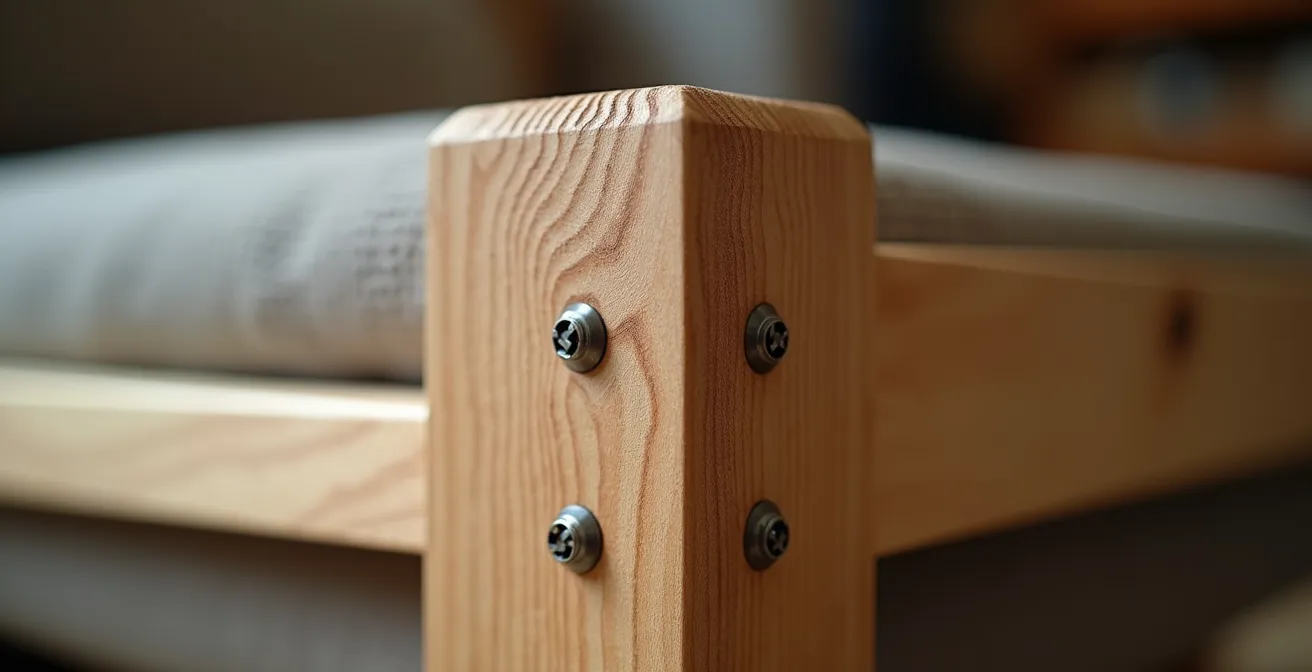
A quality frame is made of kiln-dried hardwood (oak, maple, birch) or, at the very least, high-quality plywood. Kiln drying stabilizes the wood and prevents it from twisting or cracking with humidity variations. Joints should be double-doweled, glued, and screwed, with reinforcing blocks in the corners. This type of construction guarantees rock-solid rigidity for decades.
I would like to share my experience with Newell, the quality of their sofas is very mediocre. I bought two from them, and after two years I have to buy new ones.
– A Canadian consumer, on Deconome.com
To test the frame in the store, perform the “torsion test.” Lift one of the front corners of the sofa about 6 inches (15 cm). If the other front leg lifts almost simultaneously, the structure is rigid and of good quality. If it stays on the ground, the frame is twisting—a sign of mediocre manufacturing. Don’t hesitate to feel the frame through the padding; you should only feel solid wood, without any rough edges or flexibility.
A robust frame is the promise of a silent, stable sofa capable of following you from home to home. It is the true secret of a piece of furniture that lasts a lifetime.
What does the “Double Rubs” code mean and how many do you need for a family of 4?
The upholstery is the most visible part of the sofa, but its beauty can be fleeting if its durability doesn’t match your lifestyle. To evaluate fabric durability, professionals use an industrial standard: the Wyzenbeek test, with the result expressed in “Double Rubs.” This is the endurance index for your future cover.
A “double rub” corresponds to a back-and-forth motion of a mechanical arm that rubs the fabric with a piece of cotton duck cloth. The number of cycles is counted until the fabric shows visible signs of wear (usually the breaking of two threads). The higher the number of double rubs, the more resistant the fabric is to abrasion. This information is a much more reliable selection criterion than simple touch or fabric thickness.
For residential use, the classification is as follows: a fabric rated at less than 15,000 double rubs is considered “light duty” and is only suitable for very occasional use (a chair in a guest room). Between 15,000 and 30,000 is “medium duty,” acceptable for a couple without children or pets. For a family, the threshold of 30,000 double rubs is the absolute minimum. A fabric rated at more than 30,000 double rubs is considered heavy-duty and suitable for intensive family use.
The table below, based on recommendations from professionals like Sailrite, provides a clear guide for choosing a fabric that won’t let you down.
| Number of Double Rubs | Recommended Use | Estimated Lifespan | Suitable For |
|---|---|---|---|
| Less than 15,000 | Light/Occasional use | 3-5 years | Cottage, guest room |
| 15,000 – 30,000 | Daily moderate use | 5-10 years | Couple without children |
| 30,000 – 50,000 | Heavy duty use | 10-15 years | Family with children |
| 50,000+ | Commercial use/Pets | 15+ years | Family with a dog allowed on the sofa |
Ask the salesperson for the fabric’s technical spec sheet. If the information is not available, it’s a bad sign. Good fabric is a selling point; a manufacturer has no reason to hide it. Investing in high-resistance fabric ensures your sofa will maintain its good looks for years to come.
Feathers or polyester: which fill should you choose for cushions that keep their shape?
Cushions are the soul of a sofa’s comfort. Their filling determines not only the initial softness but also their ability to keep their shape and look over time. Cushions that flatten and deform immediately give a neglected appearance to the entire piece, even if its structure is impeccable. The choice is mainly between synthetic fibers, natural materials, or a combination of both.
Polyester filling (Dacron, hollow fiber) is the most common and economical option. It offers satisfactory initial comfort but tends to pack down and form lumps over time. It requires regular fluffing and rotating to maintain a uniform appearance. It is an entry-level solution that lacks long-term resilience.
Feather and down filling offers an incomparable feeling of luxury and enveloping comfort. Feather cushions mold to the body and are extremely soft. However, they require daily maintenance: they must be “beaten” and shaken every day to redistribute the feathers and restore volume. Without this maintenance, they flatten quickly. It is also crucial to check for RDS (Responsible Down Standard) certification, which guarantees ethical sourcing.
Case Study: EQ3’s Hybrid Approach
Canadian manufacturer EQ3, with its Cello collection, perfectly illustrates the best solution: the hybrid. The seat cushions are composed of a high-density foam core for support, wrapped in a layer of feathers and polyester fibers for softness. The back cushions, meanwhile, are entirely filled with feathers for enveloping comfort. This combination offers the best of both worlds: the durable support of foam and the comfortable luxury of feathers, while minimizing maintenance.
Here are some simple maintenance steps based on the type of filling to prolong the life and appearance of your cushions:
- Polyester: Vacuum once a week and perform a full cushion rotation every month.
- Feathers/Down: Vigorously beat and shake the cushions daily to maintain their loft.
- Hybrid (foam and feathers): Flip the cushions every week and tap them lightly to air out the feather layer.
In the end, the best option is often a hybrid solution that combines a foam core for structure and a feather/down wrap for the initial feel. It is a compromise that ensures both durable support and luxurious comfort without the demanding maintenance of 100% feather cushions.
Sofa vs. side table: which piece should you splurge on and where should you save?
In living room design, not all furniture is equal in terms of wear and impact on comfort. Establishing an investment hierarchy is a smart strategy for allocating your budget effectively. The rule is simple: invest heavily in pieces that undergo daily mechanical and bodily stress, and save on elements that are purely decorative or have low usage.
The sofa is, without question, the centerpiece that justifies the largest investment. It is a piece of furniture you sit on, lie on, that children jump on, and that supports considerable weight every day. Its structure, suspension, and padding are under constant wear. A quality sofa, with a solid wood frame, springs, and dense foam, is designed to support a significant load; the sturdiest models can even support up to 600 lbs without failing, which is a guarantee of durability.
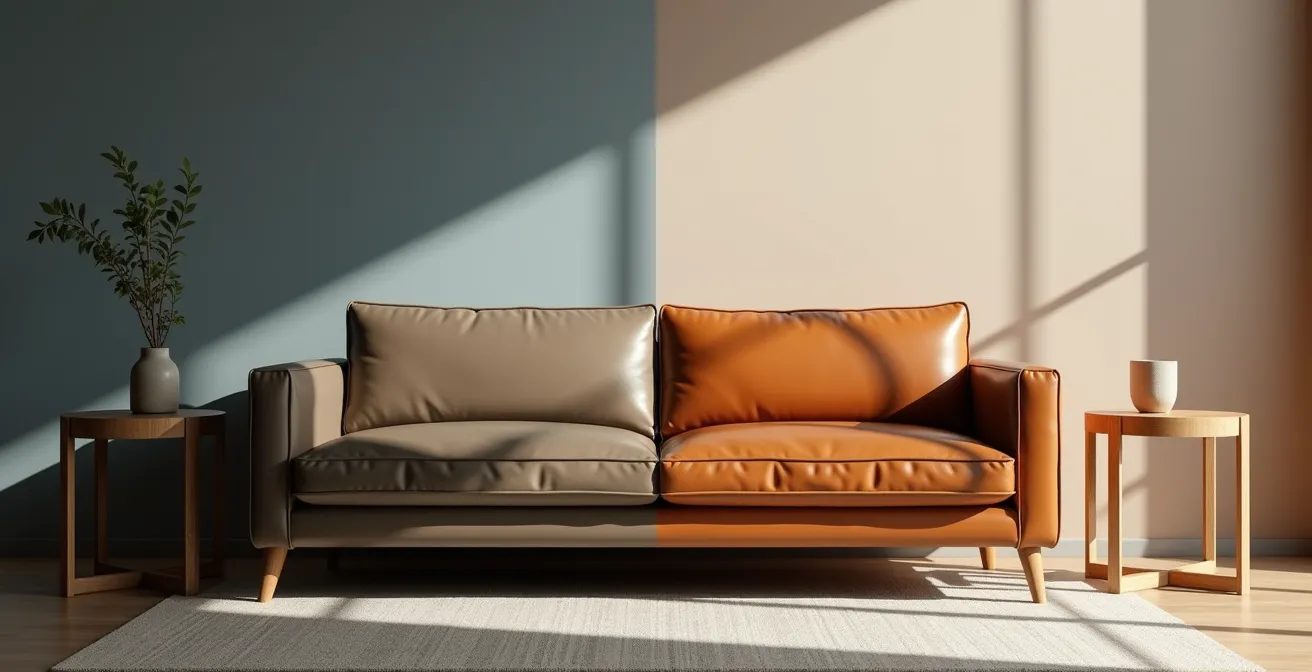
Conversely, a side table, console, or shelf are static pieces of furniture. Their role is to support a few light objects. Their structure undergoes very little stress. It is therefore quite reasonable to opt for more affordable models in MDF or veneer without compromising functionality or safety. The “cost per year of sitting” for a $4,000 sofa that lasts 15 years ($267/year) is much lower than that of a $1,000 sofa that must be replaced after 2 years ($500/year).
Testimony of a Thoughtful Investment
A consumer on the Quebec blog Deconome says: “I searched for months before buying ours, the Bubble model from Maison Corbeil. […] Five years ago, I didn’t know these shops for buying a sofa online in Canada. They are definitely worth the detour to find the sofa of your dreams because the model choices are interesting.” This testimony illustrates an investment approach: thorough research and choosing a recognized retailer in Canada for quality, like Maison Corbeil, is a winning strategy in the long term.
By concentrating your budget on a well-crafted sofa, you are investing in your comfort and peace of mind for the next 10 to 15 years. It is the smartest financial decision you can make for your living room.
Key Takeaways
- Density above all: Never accept seat foam below 2.0 lb/ft³. This is the non-negotiable technical criterion to avoid sagging.
- Structure and suspension: A solid wood frame and sinuous spring suspension guarantee a lifespan of over 10 years. Particle board and webbing should be avoided.
- Trust the numbers: The “Double Rubs” count for the fabric (minimum 30,000 for a family) is a much more reliable indicator of durability than appearance.
How to choose the right furniture size so you don’t overwhelm or empty your room?
You have identified a technically perfect sofa. The final step, and not the least, is to ensure it integrates harmoniously into your living space. A sofa that is too large can make a room feel claustrophobic and block traffic, while a model that is too small will look lost and ridiculous. Balance of proportions is the key to successful layout. It’s not just an impression; it’s a science of measurements.
The first mistake is underestimating visual bulk. A sofa with massive lines and a dark color will always appear larger than a model with thin legs and a light color, even with the same dimensions. In Canada, the emergence of “condo sofas” addresses this need for balance in more compact spaces. As specialized retailers point out, a “condo” sofa is typically 12 inches smaller than a standard sofa but remains larger than a loveseat, offering the best compromise between comfort and footprint.
Before even heading to the store, you must master the dimensions of your room and visualize the impact of the furniture. The most effective and simplest method is the tape method. It saves you from costly mistakes and disappointments upon delivery.
Your Action Plan: Validate the size with the tape technique
- Measure the available space: Take precise measurements of your room (length and width) and note the location of windows, doors, and other fixed furniture.
- Create a template on the floor: Using painter’s tape (which leaves no residue), mark out the exact dimensions (length and depth) of the sofa you desire on the floor.
- Check traffic zones: Ensure there is a circulation space of at least 90 cm (3 feet) around the template for main pathways. There is nothing worse than a living room where you have to squeeze through.
- Anticipate delivery: Measure the width of all your doors, hallways, and the stairwell. Compare these measurements to the height and depth of the sofa. Many purchases are canceled because the furniture physically cannot enter the home.
- Keep your measurements: Take a photo of your measurements and the floor template. Keep them on your phone so you can consult them at any time in the store and compare models.
By taking the time to conduct this spatial audit, you ensure that the sofa of your dreams doesn’t turn into a logistical nightmare. A quality piece of furniture is one that finds its rightful place, both in your budget and in your living room.