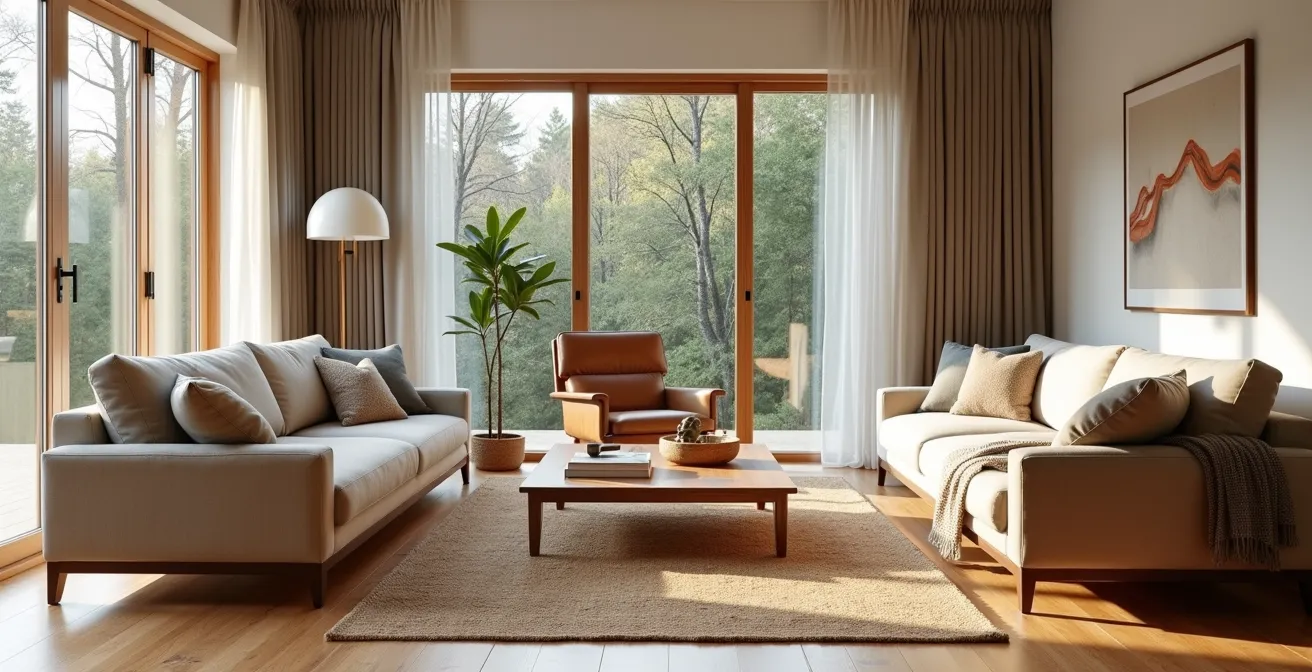
Contrary to popular belief, the key to a harmonious interior is not to match every piece of furniture, but to define a personal “stylistic DNA” that serves as a common thread.
- A mastered mix of wood species, textures, and eras creates depth and personality.
- Coherence comes from the subtle repetition of key elements (colors, materials, shapes) rather than buying complete matching sets.
Recommendation: Before choosing a piece of furniture, define three to five words that describe the atmosphere you want to create. Every purchase must serve this visual narrative.
Renovating or furnishing several rooms in your home is an exciting adventure, but it often comes with an agonizing question: how can you ensure the living room, bedroom, and dining room talk to each other harmoniously? How do you avoid a “patchwork” effect without creating a sterile interior that looks like it’s straight out of a catalog? The common reflex is to apply strict rules: stick to a single color palette, use only one wood species, or worse, buy pre-matched furniture sets.
These approaches, while reassuring, are often the shortest path to an impersonal and dated decor. They ignore the richness that comes from mixing, the warmth of textures, and the story told by mismatched but carefully chosen objects. True coherence is not found in uniformity, but in the creation of a visual narrative that runs through the entire house. The challenge is not to match everything, but to make everything resonate together.
So, if the solution isn’t in matching, where is it? The key lies in defining a personal stylistic DNA. This invisible common thread allows you to make bold decisions—mixing a family heirloom with a designer piece, marrying oak with walnut, or juxtaposing different styles—while maintaining a soul and logic in your interior. This article is designed as a roadmap to help you build this guiding thread, piece by piece, relying on fundamental design principles rather than rigid rules.
To guide you through this process, we will explore essential strategies for maintaining visual coherence without sacrificing your personality. From the art of mixing wood species to balancing masses in your living room, each section will give you the keys to orchestrating your interior like a true art director.
Summary: Creating a Coherent Visual Narrative in Your Interior
- Should you really match the coffee table with the floor, or can you mix wood species?
- Rug under the front legs or under the whole piece: the golden rule for anchoring the living room
- How to identify the feature wall in each room to orient your furniture accordingly?
- The mistake of buying a complete bedroom set that makes decor look impersonal and dated
- How to balance a massive sofa with light armchairs so the room doesn’t feel lopsided?
- The mistake of using the same flooring everywhere, making the space monotonous and impersonal
- How to combine raw wood, wool, and linen for a soothing sensory experience?
- How to define your decor style without completely copying a catalog page?
Should you really match the coffee table with the floor, or can you mix wood species?
The idea that you must match all wood species in a room is one of the most persistent myths in interior design. In reality, a judicious mix of woods is what gives depth, character, and a natural feel to a space. The true secret is not matching, but harmony. To achieve this, you must rely on a simple principle: undertones. Every wood has a color “temperature”: warm (with notes of red, orange, yellow), cool (with notes of grey, blue), or neutral.
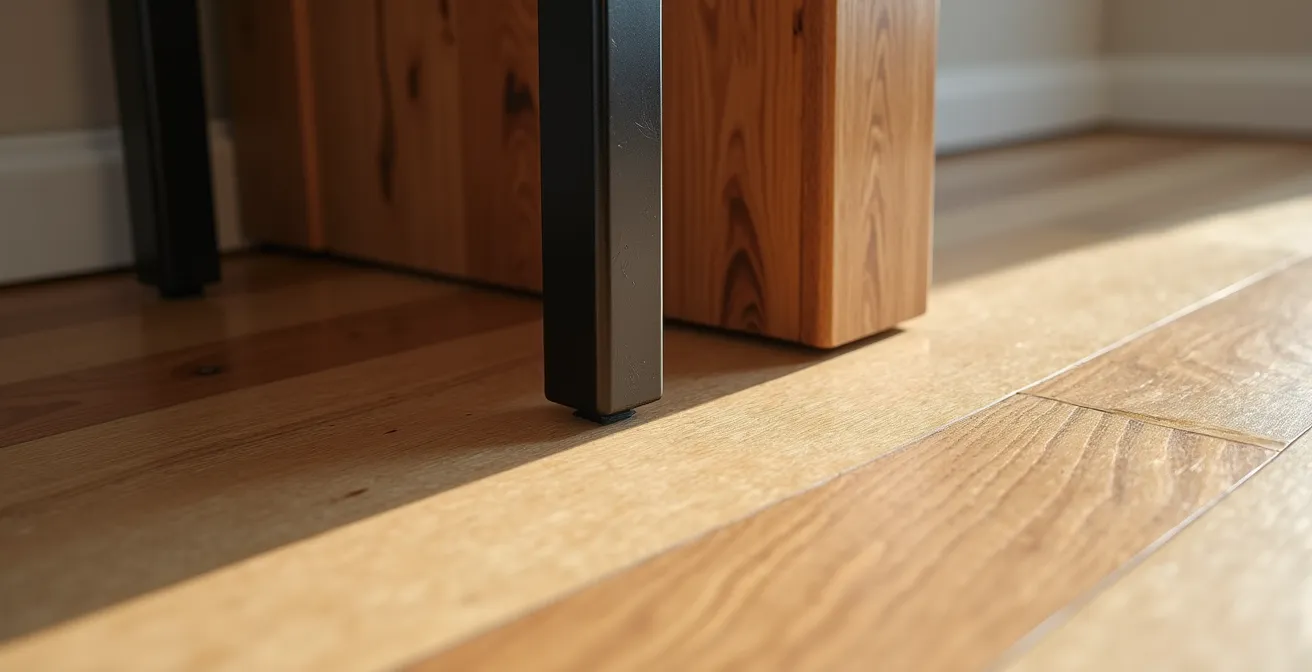
The trick is to choose woods that share the same undertone, even if their colors are different. For example, an oak floor with golden reflections will pair beautifully with a maple table that shares that warmth. To avoid chaos, limit yourself to two or three wood species per room. One of them, often the flooring, will act as the dominant species. The others will appear as secondary touches on smaller furniture or accessories. Also, think about contrast: a dark walnut table on a light pine floor creates a powerful and deliberate focal point. This is the case in a living room where light pine shelves contrast with a dark oak parquet, creating a successful visual dynamic through the repetition of each species in the space.
In short, don’t be afraid to mix. It is by playing with textures and wood tones that you will create a rich and authentic interior, far from sterile uniformity.
Rug under the front legs or under the whole piece: the golden rule for anchoring the living room
A rug is much more than a simple decorative accessory; it is the element that anchors a space, defines its boundaries, and unifies the furniture. The question of its placement is therefore crucial. The most well-known and safest rule is the “front legs” rule: the rug should be large enough so that the front feet of the sofa and main armchairs rest on it. This technique visually connects the different seating elements, creating a coherent and welcoming conversation “island.”
However, this rule must be adapted to the context, especially in large Canadian open-concept homes. In these vast spaces, a small rug can look lost. It is often wiser to opt for a large area rug that clearly delimits a functional zone, such as the living room or dining room. The rug can then go entirely under the sofa and armchairs, creating a solid visual foundation and providing an essential dose of warmth during long winters. This approach helps structure the space without the need for walls.
The choice of material is also a way to adapt the rug to Canadian seasons. A large natural fiber rug like jute can serve as a neutral base year-round, while a smaller, thicker wool rug can be layered over it in winter for maximum comfort and a “cocooning” atmosphere. The important thing is that the rug is proportional to the room and the furniture to prevent it from visually “floating” in the space.
Whether you choose the “front legs” rule for a classic space or a large rug for an open-concept area, the goal remains the same: use the rug to unify and give an intentional structure to your layout.
How to identify the feature wall in each room to orient your furniture accordingly?
In every room, there is a “feature wall” or a natural focal point. It is the first place the eye lands upon entering. Identifying it is the first step in organizing furniture in a logical and intuitive way. Often, it is a wall with a distinctive architectural feature: a fireplace, a large window with a stunning view, or a built-in niche. Orienting the main furniture toward this focal point creates a sense of order and destination.

In the Canadian context, where nature is so present, the outdoor view is often the most powerful focal point. A recent study confirms that nearly 75% of Canadian interior designers prioritize orientation toward natural views whenever possible. Placing the sofa facing a bay window looking out onto a forest landscape or a lake transforms the window into a living, changing painting. But what if the room has no obvious architectural feature? You must then create one. Several options are available to you:
- Apply a bold accent color or panoramic wallpaper, ideally inspired by local landscapes, to give weight to a wall.
- Create a gallery wall by composing a collection of frames, favoring works by local artists for a personal and authentic touch.
- Install wood paneling or wainscoting to add texture and architectural interest.
Once this feature wall is identified or created, the arrangement of the rest of the room becomes obvious. The furniture organizes itself around it, creating a natural traffic flow and a clear visual hierarchy.
The mistake of buying a complete bedroom set that makes decor look impersonal and dated
The appeal of “complete sets” for the bedroom—perfectly matched bed, nightstands, and dresser—is understandable. It’s a quick and simple solution that guarantees a form of coherence. However, it is also the surest way to create a space that is soulless, impersonal, and quickly outdated. A room furnished exclusively with a “set” looks like a hotel room or a catalog page, not a personal sanctuary that has evolved with you.
The true charm of a bedroom lies in the thoughtful mix of pieces from different sources, textures, and eras. This doesn’t mean creating chaos, but rather composing a collection of objects that tell a story. Pairing a solid wood headboard from a major retailer with vintage thrifted nightstands or a dresser designed by a local artisan creates a much richer visual dialogue. This approach not only allows you to express your style but also builds a timeless decor that you can evolve by replacing one piece at a time. The following table highlights the fundamental differences between the two approaches.
| Criterion | Complete Set | Creative Mix |
|---|---|---|
| Customization | Limited | Unlimited |
| Initial Cost | Often more economical | Variable depending on pieces |
| Evolution over time | Dates quickly | Timeless and evolvable |
| Resale Value | Low | Better for unique pieces |
| Personal Style Expression | Minimal | Maximal |
As shown in this recent comparative analysis, the “creative mix” offers far superior flexibility and customization. To ensure coherence, use unifying elements: a common color palette, the repetition of a material (like brass on handles and light fixtures), or a textile theme.
Ultimately, your bedroom should be a collection of your favorite finds, not a predefined package. This is what will make it unique and truly yours.
How to balance a massive sofa with light armchairs so the room doesn’t feel lopsided?
Visual balance is one of the pillars of a successful layout. A common mistake is placing furniture of very different visual weights without creating a link between them, giving the impression that the room “leans” to one side. A large sectional sofa, for example, can easily overwhelm two small, delicate armchairs if they are not integrated into a coherent whole. The key is not to match sizes, but to create a dynamic balance.
The first technique is triangulation. Instead of placing the armchairs directly facing the sofa, arrange them at an angle to form a conversational triangle. This creates a more natural flow and better distributes the visual weight. Next, use “visual bridges” to connect the pieces. Repeat an element from the sofa on the armchairs: a cushion of the same color, a similar texture, or a throw that echoes the sofa’s fabric. These subtle reminders tell the eye that these pieces, although different, belong to the same “group.”
Height balance is also crucial. Ideally, the armchairs should have a backrest height that is neither too high nor too low relative to the sofa. A side table or a floor lamp placed between the different seats can also serve as a binder and transitional element. As an interior design expert points out in a layout analysis:
If your wooden table is extremely imposing, pair it with chairs that have a slim and airy design rather than huge armchairs that will overwhelm the whole set. This way, you can still see your table and maintain a sense of space.
– Interior design expert, Il était une fois… Déco
This principle applies perfectly to the sofa-armchair balance. A massive sofa requires lighter companions to avoid saturating the space.
By using these triangulation, repetition, and height-balancing techniques, you can combine furniture of very different sizes and styles while creating a harmonious and well-proportioned living room.
The mistake of using the same flooring everywhere, making the space monotonous and impersonal
In modern homes, especially Canadian builds with large open areas, the temptation is great to use the same flooring everywhere to unify the space. While this approach may seem logical, it often leads to a monotonous result that lacks definition. Flooring is a powerful opportunity to subtly delimit functional zones, add texture, and meet the specific needs of each room.
Varying floor coverings does not mean creating a visual break. It is about creating harmonious transitions. For example, oak parquet in a living room can elegantly transition to a warm-toned ceramic tile in the adjacent kitchen. In a typical Canadian home, oak parquet in the living room can be paired with spruce planks in a neighboring room, by staining the spruce to match the oak’s shade, thus ensuring a soft visual continuity. The choice of covering should be guided by the room’s function, especially in a climate like Canada’s:
- Entrance: Durable ceramic tile, ideally with a heated floor system, is perfect for resisting snow, water, and road salt in winter.
- Living Room: Hardwood like maple or oak brings unmatched warmth and conviviality, creating a welcoming space.
- Kitchen: Quality tile or luxury vinyl is easy to clean and resistant, while offering design options that can harmonize with the wood in other rooms.
- Bedrooms: Wood with area rugs or wall-to-wall carpeting provides appreciable thermal and acoustic comfort.
- Basement: Waterproof vinyl or carpeting are excellent choices for insulation and managing potential humidity.
By adapting the flooring to the function, you don’t just create a more practical interior, but also a richer and better-defined one, where each space has its own identity while being part of a coherent whole.
How to combine raw wood, wool, and linen for a soothing sensory experience?
Beyond the visual aspect, a truly harmonious interior appeals to all the senses. Creating a “sensory signature” involves the judicious pairing of textures. The trio of raw wood, wool, and linen is particularly powerful for creating a soothing, authentic atmosphere deeply connected to nature—a principle at the heart of biophilic design, which is very relevant in the Canadian context. These natural materials share an honesty and warmth that invite calm and well-being.
Raw wood, with its visible grain and imperfections, serves as a solid and warm foundation. It can be present on furniture, flooring, or exposed beams. Linen, with its slightly wrinkled appearance and lightness, brings freshness and light. It is ideal for curtains, table linens, or summer cushion covers. Wool, meanwhile, provides unmatched depth, softness, and comfort, essential for creating a “hygge” vibe during Canadian winters. It is found in thick throws, cozy rugs, and plush cushions.
Harmony comes from the balance and layering of these textures throughout the seasons. Think of your decor like a wardrobe:
- The Base: Wooden furniture and linen curtains constitute the permanent anchor pieces.
- Spring/Summer: Emphasize linen with light-colored cushion covers and lightweight throws for a feeling of freshness.
- Autumn: Introduce intermediate textures like fine wool knits.
- Winter: Generously layer thick wool. A chunky knit throw on the sofa or a sheepskin rug at the foot of the bed maximizes comfort and warmth.
For an even more personal result, prioritize pieces from local artisans that tell a story and strengthen the link with your environment.
By orchestrating this dialogue between wood, wool, and linen, you transform your home into a true sensory cocoon, a soothing refuge that evolves with the rhythm of nature.
Key Takeaways
- Stylistic DNA takes precedence over style: define the emotion and function of each room before choosing furniture.
- Coherence is born from mastered contrast: mix wood species, furniture volumes, and styles to create a dynamic and personal interior.
- Textures are the invisible binder: use natural materials like wood, wool, and linen to unify the space and create a rich sensory experience.
How to define your decor style without completely copying a catalog page?
We arrive at the heart of the process: creating your own common thread. Copying a magazine style might seem like a safe solution, but it rarely leads to an interior where you truly feel at home. The key to avoiding this pitfall is not to start by looking for a style (Scandinavian, industrial, bohemian), but by defining your personal stylistic DNA. It is an introspective process that involves translating your personality, needs, and aspirations into a visual language.
This stylistic DNA is a set of guiding principles that will lead you in every decision, from the wall color to the purchase of a new armchair. It ensures that even when mixing genres and eras, your interior remains coherent and true to who you are. It is not a list of rules, but a compass. For example, your DNA might be “welcoming, creative, connected to nature,” which would naturally steer you toward raw materials, warm colors, and spaces that foster conversation. For another, it might be “minimalist, serene, functional,” leading toward clean lines and smart storage solutions. The following action plan will help you formalize this DNA.
Action Plan: Define Your Stylistic DNA in 5 Steps
- Personal Analysis: Look at your wardrobe and the objects you already love. Identify recurring colors, textures, and shapes that instinctively attract you.
- Define Function: For each room, define 3 to 5 action verbs describing what you want to do and feel there (e.g., “recharge, read, create,” “host, share, laugh”).
- Create Keywords: Synthesize your observations into a list of 5 keywords that will form your stylistic DNA (e.g., Natural, Bright, Simple, Warm, Authentic).
- The Filter Test: Before every new purchase or decor decision, ask yourself: “Does this object serve my stylistic DNA? Is it ‘Natural, Bright, Simple’?” If the answer is no, move on.
- Document and Refine: Take photos of your successful arrangements. Note why they work. Your style is not static; it will evolve. This process will help you refine it with confidence.
By following this method, you will never again choose a piece of furniture because it is “trendy,” but because it is a true expression of yourself. Start defining your stylistic DNA today and transform every room into an authentic chapter of your own story.